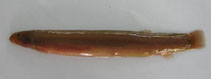
Ambiente: milieu / zona climatica / distribuzione batimetrica / gamma di distribuzione
Ecologia
; acqua dolce demersale. Tropical
Asia: India, Bangladesh, Myanmar.
Dimensione / Peso / Età
Maturità: Lm ? range ? - ? cm
Max length : 6.5 cm TL maschio/sesso non determinato; (Ref. 85009)
Breve descrizione
Chiavi di identificazione | Morfologia | Morfometria
Raggi dorsali molli (totale) : 10; Raggi anali molli: 9; Vertebre: 47 - 52. Differs from members of the P. kuhlii and P. shelfordii groups and the Myanmar P. signicauda and P. lumbriciformis by having plain brown color pattern. Distinguished from species of the P. anguillaris group and P. signicauda and P. lumbriciformis by possessing fewer abdominal vertebrae (34-39 vs 40-52). Differs from the other members of the P. oblonga group by the following characters: from P. filinaris and P. mariarum by the absence of the nasal barbel (vs presence) and from P. oblonga by a narrower body (7.6-9 times SL vs 7.2-7.7). Can be differentiated from all other Myanmar species by the longer pectoral fins (8.2-9.6 % SL vs 5.3-7.0), and further from P. elongata, P. lumbriciformis and P. signicauda by a deeper body (body depth 13.5-16.3 % SL vs 6.5-9.3) and a deeper (caudal peduncle depth 7.5-9.7 % SL vs 4.1-5.5 % SL) and shorter caudal peduncle (caudal peduncle length 10.5-12.5 % SL vs 14.9-16.6 % SL), from P. fusca and P. apoda by presence of the pelvic girdle and pelvic fins (vs absence), from P.signicauda and P. lumbriciformis by the plain brown coloration (vs with dark marks on body and fins), from P. fusca by the number of abdominal vertebrae (34-39 vs 41-44) and the absence of a nasal barbel (vs presence), and from P. elongata by relatively more posteriorly placed pelvic fins (prepelvic length 79-86.8 % SL vs 56.3 % SL) (Ref. 57993).
Body shape (shape guide): elongated.
Facultative air-breathing in the genus (Ref. 126274); Inhabits slow moving rivers with sandy bottom (Ref. 41236).
Ciclo vitale e comportamento di accoppiamento
Maturità | Riproduzione | Deposizione | Uova | Fecondità | Larve
Menon, A.G.K., 1999. Check list - fresh water fishes of India. Rec. Zool. Surv. India, Misc. Publ., Occas. Pap. No. 175, 366 p. (Ref. 41236)
Stato della Lista Rossa IUCN (Ref. 130435: Version 2025-2 (Global))
Minaccia per l'uomo
Harmless
Usi umani
Pesca: di nessun interesse
Strumenti
Rapporti speciali
Scarica XML
Fonti Internet
Stime basate su modelli
Indice di diversità filogenetica (Fonte Biblio.
82804): PD
50 = 0.5000 [Uniqueness, from 0.5 = low to 2.0 = high].
Bayesian length-weight: a=0.00347 (0.00184 - 0.00655), b=2.98 (2.82 - 3.14), in cm total length, based on LWR estimates for this species & (Sub)family-body (Ref.
93245).
Livello trofico (Fonte Biblio.
69278): 3.4 ±0.4 se; based on size and trophs of closest relatives
Resilienza (Fonte Biblio.
120179): Alto, tempo minimo di raddoppiamento della popolazione meno di 15 mesi (Preliminary K or Fecundity.).
Vulnerabilità della pesca (Ref.
59153): Low vulnerability (10 of 100).
🛈