>
Siluriformes (Catfishes) >
Akysidae (Stream catfishes) > Parakysinae
Etymology: hypselurus: From the Greek hypselos for high and oura for tail, in reference to the relatively tall neural spines of the caudal vertebrae (Ref. 45707).
Eponymy: Dr Heinrich Breitenstein (1848–1930) was a German physician who served with the Dutch East Indies army for 21 years. [...] (Ref. 128868), visit book page.
Entorno: milieu / zona climática / rango de profundidad / gama de distribución
Ecología
; agua dulce demersal. Tropical
Asia: Borneo, Indonesia.
Tamaño / Peso / Edad
Madurez: Lm ? range ? - ? cm
Max length : 12.2 cm SL macho / no sexado; (Ref. 45707)
Descripción breve
Claves de identificación | Morfología | Morfometría
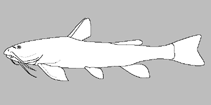
Espinas dorsales (total) : 1; Radios blandos dorsales (total) : 5; Espinas anales: 0; Radios blandos anales: 10; Vértebra: 42. Differentiated by its relatively tall neural spines in the caudal vertebrae, shorter caudal peduncle (26.0% SL versus 30.7-36.8), longer snout (35.5% HL versus 27.2-34.1), more wide-set eyes (interorbital distance 30.9% HL versus 27.2-34.1), fewer vertebrae (42 versus 44-45), and smooth (versus serrated) dorsal spine (Ref. 45707).
Body shape (shape guide): elongated.
Ciclo vital y comportamiento de apareamiento
Madurez | Reproducción | Puesta | Huevos | Fecundidad | Larva
Ng, H.H. and D.J. Siebert, 1998. A revision of the akysid catfish genus Breitensteinia Steindachner with descriptions of two new species. J. Fish Biol. 53(3):645-657. (Ref. 45707)
Situación en la Lista Roja de la UICN (Ref. 130435: Version 2025-2 (Global))
Amenaza para el ser humano
Harmless
Usos humanos
Herramientas
Informes especiales
Descargar XML
Fuentes de Internet
Estimaciones basadas en modelos
Índice de diversidad filogenética (Referencia
82804): PD
50 = 0.6250 [Uniqueness, from 0.5 = low to 2.0 = high].
Bayesian length-weight: a=0.00389 (0.00180 - 0.00842), b=3.12 (2.94 - 3.30), in cm total length, based on all LWR estimates for this body shape (Ref.
93245).
Nivel trófico (Referencia
69278): 3.9 ±0.6 se; based on size and trophs of closest relatives
Vulnerabilidad pesquera (Ref.
59153): Low vulnerability (10 of 100).
🛈