>
Cichliformes (Cichlids, convict blennies) >
Cichlidae (Cichlids) > Pseudocrenilabrinae
Etymology: Haplochromis: Greek, Haploos = single + Greek, chromis = a fish, perhaps a perch (Ref. 45335); pyrrhopteryx: The specific name refers to the bright, orange-red coloration of the median fins which is present in live specimens of both sexes, juveniles as well as adults (Ref. 42172).
Environnement : milieu / zone climatique / profondeur / gamme de distribution
Écologie
; eau douce benthopélagique; profondeur 2 - 20 m (Ref. 42172), usually 10 - 16 m (Ref. 42172). Tropical
Africa: Lake Victoria.
Longueur à la première maturité / Taille / Poids / Âge
Maturité: Lm 13.5 range ? - ? cm
Max length : 19.7 cm SL mâle / non sexé; (Ref. 42172); 19.3 cm SL (female)
Description synthétique
Clés d'identification | Morphologie | Morphométrie
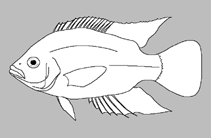
Épines dorsales (Total) : 14 - 17; Rayons mous dorsaux (Total) : 8 - 10; Épines anales: 3; Rayons mous anaux: 8 - 10; Vertèbres: 29 - 30. Diangosis: body moderately elongate, the head having a rather 'heavy' appearance (Ref. 42172). Snout somewhat blunt; mouth moderately oblique (Ref. 42172). Tip of the lower jaw always slightly protruding, rostral outline of lower jaw slightly convex (Ref. 42172). Strongly recurved unicuspid teeth in the oral jaws (Ref. 42172): 52-64 teeth in outer row of the premaxilla, 36-56 teeth in outer row of the lower jaw (Ref. 42172). Pectoral and pelvic fins not quite reaching the anal fin; anal and dorsal fin not reaching base of caudal fin (Ref. 42172). Cheek and nuchal area with cycloid scales only, gill cover with more cycloid scales than weakly ctenoid scales; scales on nape and body ctenoid (Ref. 42172). Live colors for males and females are black on ventral parts of head and body (Ref. 42172, 74923) and orange dorsally (Ref. 42172). All median fins orange; males and females have black pelvic fins (Ref. 42172). No midlateral band (Ref. 74923).
Body shape (shape guide): fusiform / normal.
Cycle de vie et comportement reproducteur
Maturité | Reproduction | Frai | Œufs | Fécondité | Larves
van Oijen, M.J.P., 1991. A systematic revision of the piscivorous haplochromine Cichlidae (Pisces: Teleostei) of Lake Victoria (East Africa). Part I. Zool. Verh. Leiden 272:95 p. (Ref. 42172)
Statut dans la liste rouge de l'IUCN (Ref. 130435: Version 2025-2 (Global))
Menace pour l'homme
Harmless
Utilisations par l'homme
Outils
Articles particuliers
Télécharger en XML
Sources Internet
Estimations basées sur des modèles
Indice de diversité phylogénétique (Réf.
82804): PD
50 = 0.5000 [Uniqueness, from 0.5 = low to 2.0 = high].
Bayesian length-weight: a=0.01445 (0.00671 - 0.03113), b=2.99 (2.82 - 3.16), in cm total length, based on LWR estimates for this (Sub)family-body shape (Ref.
93245).
Niveau trophique (Réf.
69278): 4.1 ±0.69 se; based on food items.
Résilience (Réf.
120179): Haut, temps minimum de doublement de population inférieur à 15 mois (Preliminary K or Fecundity.).
Vulnérabilité de la pêche (Ref.
59153): Low vulnerability (14 of 100).
🛈