Taxonomic Remarks
Genus Williams, pers. comm.
पर्यावरण: पर्यावरण / जलवायु क्षेत्र / गहराई सीमा / वितरण सीमा
पारिस्थितिकी
समुद्री प्रवाल-भित्ति संयुक्त; गहराई सीमा 0 - 3 m (Ref. 30874). Tropical; 30°N - 30°S
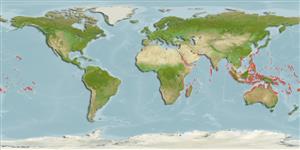
Indo-Pacific: Red Sea south to Durban, South Africa, east to the Marquesas and Tuamoto Islands, north to the Ryukyu Islands; throughout Micronesia.
आकार / वज़न / आयु
परिपक्व अवधि: Lm ? range ? - ? cm
Max length : 15.0 cm SL पुल्लिंग / अलिंग; (Ref. 9710)
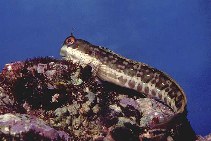
पृष्ठीय रीढ़ (सम्पूर्ण) : 12 - 14; पृष्ठीय सौफट रेज़ (सम्पूर्ण) : 18 - 21; गुदा कांटा: 2; ऐनल सौफट रेज़: 19 - 21; जानवरों की रीड़ का जोड़: 25 - 27. Diagnosis: Dorsal fin XIII, 18-21, notched between spinous and segmented-ray portions; anal fin II, 19-21; pectoral rays 13-15 (usually 14); pelvic fin I, 3; caudal fin, procurrent rays 7, segmented rays 13. Vertebrae 12 + 25-27. Orbital cirrus simple and slender, may have a short lateral branch, less often up to 4 branches; nasal cirri short and palmate, may rarely have more than 6 branches; nuchal cirri simple and slender, may have a single branch or a ragged edge. Mandibular pores 6. Dorsal lips margin entire, ventral margin crenulated. Occipital crest absent, but large males have a low thin ridge (less than 1.8 mm); no crest or ridge in females Three color-pattern types described for different localities (see Ref. 9962). Body of males with 6-7 dusky bands with 1 or a pair of dark margined, pale, oblong spots on each band; dark spots on spinous dorsal, dusky lines on rayed dorsal. Females with spots on caudal peduncle; body sometimes with fine dark specks (Ref. 4404). Body depth at anal-fin origin 4.6-5.3 in SL (Ref. 90102).
Body shape (shape guide): elongated.
Adults inhabit exposed outer intertidal reef flats, where it can hide in cracks and holes. Commonly observed clinging to rocks as the water recedes below them during the low cycle of the swell and this species is often confused with mudskipper gobies (Ref. 48636). They feed on filamentous algae and associated small invertebrates, such as foraminiferans, ostracods, copepods, and gastropods. Oviparous. Eggs are demersal and adhesive (Ref. 205), and are attached to the substrate via a filamentous, adhesive pad or pedestal (Ref. 94114). Larvae are planktonic, often found in shallow, coastal waters (Ref. 94114). Rarely used for aquarium fish.
जीवन चक्र और संभोग व्यवहार
परिपक्व अवधि | पुनरुत्पत्ति | मछलीऔ का अंडे देना | अंडे | उपजाऊपन | लार्वा
Distinct pairing (Ref. 205).
Springer, V.G. and J.T. Williams, 1994. The Indo-West Pacific blenniid fish genus Istiblennius reappraised: a revision of Istiblennius, Blenniella, and Paralticus, new genus. Smithson. Contrib. Zool. 565:1-193. (Ref. 9962)
आईयूसीएन रेड लिस्ट स्थिति (Ref. 130435: Version 2025-2 (Global))
मनुष्यों के लिए ख़तरा
Harmless
मानव उपयोग
मात्स्यिकी: कोई रुचि बग़ैर
साधन
विशेष रिपोर्ट
XML डाउनलोड करें
इंटरनेट स्रोत
मॉडल पर आधारित अनुमान
पसंदीदा तापमान (संदर्भ
123201): 25 - 29.3, mean 28.4 °C (based on 2554 cells).
जातिवृति विविधता सूचकांक (संदर्भ
82804): PD
50 = 0.5020 [Uniqueness, from 0.5 = low to 2.0 = high].
Bayesian length-weight: a=0.00776 (0.00354 - 0.01702), b=3.00 (2.81 - 3.19), in cm total length, based on LWR estimates for this (Sub)family-body shape (Ref.
93245).
ट्रॉफिक स्तर (संदर्भ
69278): 3.3 ±0.43 se; based on food items.
लौटाव (संदर्भ
120179): माध्यम, न्यूनतम जनसंख्या दुगनी होने का समय 1.4 - 4.4 वर्ष। (Preliminary K or Fecundity.).
मछली पकड़ने की भेद्यता (Ref.
59153): Low vulnerability (10 of 100).
🛈
पोषक तत्व (Ref.
124155): Calcium = 115 [56, 183] mg/100g; Iron = 0.664 [0.377, 1.120] mg/100g; Protein = 18.5 [17.3, 19.6] %; Omega3 = 0.0767 [, ] g/100g; Selenium = 16.1 [7.5, 34.7] μg/100g; VitaminA = 144 [44, 446] μg/100g; Zinc = 1.83 [1.21, 2.64] mg/100g (wet weight);