>
Blenniiformes (Blennies) >
Blenniidae (Combtooth blennies) > Blenniinae
Etymology: Aspidontus: Greek, aspis, -idos = shield + Latin, dens, dentis = teeth (Ref. 45335).
Eponymy: Jean-Jacques Dussumier (1792–1883) was a French merchant, collector, traveller and ship owner. [...] (Ref. 128868), visit book page.
More on author: Valenciennes.
Ambiente: milieu / zona climatica / distribuzione batimetrica / gamma di distribuzione
Ecologia
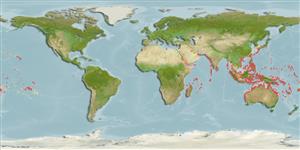
marino associati a barriera corallina; distribuzione batimetrica 1 - 20 m (Ref. 90102). Tropical; 32°N - 32°S
Indo-Pacific: Red Sea south to Knysna, South Africa (Ref. 4404) and east to Tuamoto Islands, north to southern Japan, south to northern New South Wales; Palau to eastern Caroline Islands, Marshall Islands in Micronesia.
Dimensione / Peso / Età
Maturità: Lm ? range ? - ? cm
Max length : 12.0 cm TL maschio/sesso non determinato; (Ref. 9710)
Breve descrizione
Chiavi di identificazione | Morfologia | Morfometria
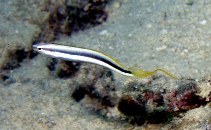
Spine dorsali (totale) : 9 - 11; Raggi dorsali molli (totale) : 28 - 34; Spine anali: 2; Raggi anali molli: 25 - 30. A. dussumieri differs from the A. taeniatus taeniatus by having a nearly terminal mouth and different color pattern, sometimes with elongate ocellus in front of dorsal fin (Ref. 37816). Indonesian populations have long yellow filaments on caudal fin. Recognized by the slender body and single dark mid-lateral stripe from the tip of the snout to the caudal fin (Ref. 48636).
Body shape (shape guide): elongated.
Common in coral reefs and rocky areas (Ref. 559, 637). Feed on algae and detritus. Generally a shy species that quickly retreats to its hiding holes, usually empty tube-worm homes, retreating backwards (Ref. 48636). Oviparous. Eggs are demersal and adhesive (Ref. 205), and are attached to the substrate via a filamentous, adhesive pad or pedestal (Ref. 94114). Larvae are planktonic, often found in shallow, coastal waters (Ref. 94114).
Ciclo vitale e comportamento di accoppiamento
Maturità | Riproduzione | Deposizione | Uova | Fecondità | Larve
Distinct pairing (Ref. 205).
Myers, R.F., 1991. Micronesian reef fishes. Second Ed. Coral Graphics, Barrigada, Guam. 298 p. (Ref. 1602)
Stato della Lista Rossa IUCN (Ref. 130435: Version 2025-2 (Global))
Minaccia per l'uomo
Harmless
Usi umani
Pesca: commerciale; Acquario: Commerciale
Strumenti
Rapporti speciali
Scarica XML
Fonti Internet
Stime basate su modelli
Temperatura preferita (Fonte Biblio.
123201): 24.7 - 29.3, mean 28.4 °C (based on 3320 cells).
Indice di diversità filogenetica (Fonte Biblio.
82804): PD
50 = 0.7500 [Uniqueness, from 0.5 = low to 2.0 = high].
Bayesian length-weight: a=0.00575 (0.00255 - 0.01297), b=3.06 (2.87 - 3.25), in cm total length, based on LWR estimates for this (Sub)family-body shape (Ref.
93245).
Livello trofico (Fonte Biblio.
69278): 2.0 ±0.00 se; based on food items.
Resilienza (Fonte Biblio.
120179): Alto, tempo minimo di raddoppiamento della popolazione meno di 15 mesi (Preliminary K or Fecundity.).
Vulnerabilità della pesca (Ref.
59153): Low vulnerability (10 of 100).
🛈
Nutrienti (Ref.
124155): Calcium = 136 [66, 232] mg/100g; Iron = 0.803 [0.459, 1.410] mg/100g; Protein = 17.9 [16.7, 19.0] %; Omega3 = 0.0825 [, ] g/100g; Selenium = 25.9 [12.3, 58.3] μg/100g; VitaminA = 103 [25, 429] μg/100g; Zinc = 2.43 [1.59, 3.51] mg/100g (wet weight);