>
Blenniiformes (Blennies) >
Blenniidae (Combtooth blennies) > Blenniinae
Etymology: Meiacanthus: Greek, meion = less = lessen + Greek, akantha = thorn (Ref. 45335).
More on author: Günther.
Περιβάλλον: περιβάλλον / κλιματική ζώνη / εύρος βάθους / εύρος διανομής
Οικολογία
Θαλασσινό(ά) Υφαλόφιλο(α); εύρος βάθους 0 - 30 m (Ref. 128797). Tropical; 30°N - 24°S
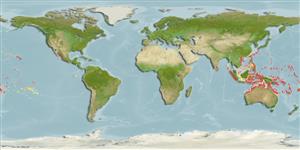
Western Pacific: Bali and the Philippines east to Samoa, north to Ryukyu Islands, south to Rowley Shoals, the southern Great Barrier Reef, and New Caledonia; throughout Micronesia. Replaced by the uniformly yellow species ovalauensis in Fiji, and by Meiacanthus tongaensis in Tonga (Ref. 37816).
Μέγεθος / Βάρος / Ηλικία
Γεννητική Ωρίμανση: Lm ? range ? - ? cm
Max length : 11.0 cm TL αρσενικό/απροσδιόριστο; (Ref. 9710)
Σύντομη περιγραφή
Κλείδες προσδιορισμού | Μορφολογία | Μορφομετρία
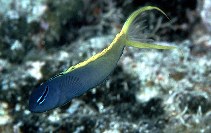
Ραχιαίες άκανθες (συνολικά) : 4; Μαλακές ραχιαίες ακτίνες (συνολικά) : 25 - 28; Εδρικές άκανθες: 2; Μαλακές εδρικές ακτίνες: 15 - 18. Identified by the blue-edged diagonal black line from the eye and yellow dorsal fin or back. Adults have long filaments on the caudal fin tips; length without filaments (Ref. 48636).
Body shape (shape guide): elongated.
Adults are found solitary or in pairs (Ref. 90102) in lagoon and seaward reefs below the surge zone to 30 m depth (Ref. 9710). A common species, often seen along slopes and drop-offs, adults sometimes in small groups (Ref. 48636). Feed on zooplankton and also on small benthic invertebrates. Inoffensive, but immune from predation (Ref. 9710). Oviparous. Eggs are demersal and adhesive (Ref. 205), and are attached to the substrate via a filamentous, adhesive pad or pedestal (Ref. 94114). Larvae are planktonic, often found in shallow, coastal waters (Ref. 94114). Mimicked by Ecsenius bicolor and Plagiotremus laudanus (Ref. 90102).
Κύκλος ζωής και συμπεριφορά ζευγαρώματος
Γεννητική Ωρίμανση | Αναπαραγωγή | Γεννοβολία | Αβγά | Γονιμότητα | Προνύμφες
Oviparous, distinct pairing (Ref. 205).
Myers, R.F., 1991. Micronesian reef fishes. Second Ed. Coral Graphics, Barrigada, Guam. 298 p. (Ref. 1602)
Κατάσταση Κόκκινου Καταλόγου IUCN (Ref. 130435: Version 2025-2 (Global))
Ανθρώπινες χρήσεις
αλιεία: Εμπορικό(ά); Ενυδρείο: Εμπορικό(ά)
Εργαλεία
Ειδικές εκθέσεις
Λήψη XML
Διαδικτυακές πηγές
Εκτιμήσεις βάσει μοντέλων
Προτιμώμενη θερμοκρασία (Αναφ.
123201): 25.6 - 29.3, mean 28.5 °C (based on 1837 cells).
Δείκτης φυλογενετικής ποικιλότητας (Αναφ.
82804): PD
50 = 0.5000 [Uniqueness, from 0.5 = low to 2.0 = high].
Bayesian length-weight: a=0.00575 (0.00255 - 0.01297), b=3.06 (2.87 - 3.25), in cm total length, based on LWR estimates for this (Sub)family-body shape (Ref.
93245).
Τροφικό Επίπεδο (Αναφ.
69278): 3.5 ±0.41 se; based on food items.
Ελαστικότητα (Αναφ.
120179): Υψηλό, ελάχιστος χρόνος για διπλασιασμό πληθυσμού < 15 μήνες (Preliminary K or Fecundity.).
Ευπάθεια στην αλιεία (Ref.
59153): Low vulnerability (10 of 100).
🛈
Θρεπτικά συστατικά (Ref.
124155): Calcium = 126 [67, 200] mg/100g; Iron = 0.726 [0.440, 1.189] mg/100g; Protein = 18.4 [17.4, 19.5] %; Omega3 = 0.104 [0.060, 0.178] g/100g; Selenium = 25.1 [12.1, 50.0] μg/100g; VitaminA = 142 [47, 405] μg/100g; Zinc = 1.81 [1.21, 2.54] mg/100g (wet weight);