>
Blenniiformes (Blennies) >
Blenniidae (Combtooth blennies) > Blenniinae
Etymology: Petroscirtes: Latin, petra, -ae = stone + Greek, skirteo = to jump.
More on author: Valenciennes.
Umwelt: Milieu / Klimazone / Tiefenbereich / Verbreitungsgebiet
Ökologie
seewasser; brackwasser riff-verbunden; tiefenbereich 1 - 15 m, usually ? - 10 m (Ref. 48636). Tropical; 22°C - 28°C; 30°N - 30°S
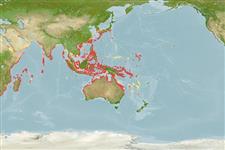
Indo-West Pacific: East Africa to Papua New Guinea, north to southern Japan, south to New Caledonia.
Größe / Gewicht / Alter
Geschlechtsreife: Lm ? range ? - ? cm
Max length : 11.0 cm SL Männchen/unbestimmt; (Ref. 1602)
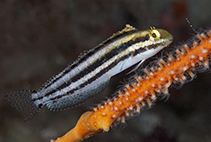
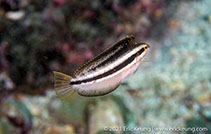
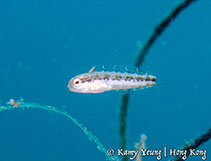
Rückenflossenstacheln (insgesamt) : 10 - 11; Rückenflossenweichstrahlen (insgesamt) : 17 - 21; Afterflossenstacheln: 2; Afterflossenweichstrahlen: 17 - 21. Dark, broad stripe from snout through eye to caudal fin; stripe may be broken into segments (Ref. 4404). Highly variable in color and mimics Meiacanthus species (Ref. 48636).
Body shape (shape guide): elongated.
Adults inhabit coastal reefs and estuaries to depths of about 10 m (Ref. 48636). May also be found up to 15 m depth in coastal and lagoon reefs in sandy and weedy areas among clumps of Sargassum or other seaweeds. They also take shelter and nests inside small-necked bottles and abandoned worm tubes or shells (Ref. 90102). They feed on small crustaceans, diatoms, and perhaps other plant material associated with such clumps. They use their fangs defensively and will not hesitate to bite if handled, thus, species of this genus are avoided by predators (Ref. 205). Oviparous. Males uses shells but also ring-top cans for nesting (Ref. 48636). Eggs are demersal and adhesive (Ref. 205), and are attached to the substrate via a filamentous, adhesive pad or pedestal (Ref. 94114). Larvae are planktonic, often found in shallow, coastal waters (Ref. 94114). Mimic of Meiacanthus grammistes, which like all species of that genus possesses a pair of large grooved fangs in the lower jaw with associated venom glands. These bites are used defensively and Papuan variety is also a possible mimic of Meiacanthus vittatus (Ref. 90102).
Lebenszyklus und Paarungsverhalten
Geschlechtsreife | Fortpflanzung | Ablaichen | Eier | Fruchtbarkeit | Larven
Oviparous, distinct pairing (Ref. 205).
Myers, R.F., 1991. Micronesian reef fishes. Second Ed. Coral Graphics, Barrigada, Guam. 298 p. (Ref. 1602)
IUCN Rote Liste Status (Ref. 130435: Version 2025-2 (Global))
Bedrohung für Menschen
Traumatogenic (Ref. 1602)
Nutzung durch Menschen
Fischereien: kommerziell; Aquarium: Kommerziell
Tools
Zusatzinformationen
Download XML
Internet Quellen
Schätzungen auf der Grundlage von Modellen
Bevorzugte Temperatur (Ref.
123201): 25 - 29.3, mean 28.5 °C (based on 2854 cells).
Phylogenetischer Diversitätsindex (Ref.
82804): PD
50 = 0.5005 [Uniqueness, from 0.5 = low to 2.0 = high].
Bayesian length-weight: a=0.00575 (0.00255 - 0.01297), b=3.06 (2.87 - 3.25), in cm total length, based on LWR estimates for this (Sub)family-body shape (Ref.
93245).
Trophische Ebene (Ref.
69278): 2.1 ±0.2 se; based on diet studies.
Widerstandsfähigkeit (Ref.
120179): hoch, Verdopplung der Population dauert weniger als 15 Monate. (Preliminary K or Fecundity.).
Anfälligkeit der Fischerei (Ref.
59153): Low vulnerability (10 of 100).
🛈
Nährstoffe (Ref.
124155): Calcium = 141 [64, 242] mg/100g; Iron = 0.758 [0.421, 1.364] mg/100g; Protein = 18.1 [16.9, 19.3] %; Omega3 = 0.0887 [, ] g/100g; Selenium = 21.8 [9.6, 51.3] μg/100g; VitaminA = 114 [30, 410] μg/100g; Zinc = 2.87 [1.87, 4.40] mg/100g (wet weight);