Classification / Noms
Noms communs | Synonymes | Catalog of Fishes(Genre, Espèce) | ITIS | CoL | WoRMS | Cloffa
>
Centrarchiformes (Basses) >
Kuhliidae (Aholeholes)
Etymology: Kuhlia: Because of Heindrich Kuhl, 1797-1821; researcher also with lizards (Gekkonidae).
Eponymy: Dr Heinrich Kuhl (1797–1821) was a German naturalist and zoologist. [...] Arthur Petit was a Pharmacist’s Mate (a rank in the US Navy), who helped Leonard Schultz collect fishes on Canton and Enderbury Islands (now in Kiribati). (Ref. 128868), visit book page.
More on author: Schultz.
Environnement : milieu / zone climatique / profondeur / gamme de distribution
Écologie
marin benthopélagique; profondeur 0 - 6 m (Ref. 89972). Tropical
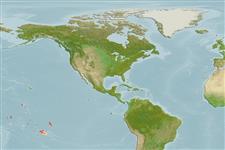
Eastern Central Pacific: known only from the Phoenix, Marquesas, and Malden Islands. Possibly in other southern Line Islands and in the northern Cook Islands.
Taille / Poids / Âge
Maturité: Lm ? range ? - ? cm
Max length : 20.1 cm SL mâle / non sexé; (Ref. 41640)
Description synthétique
Clés d'identification | Morphologie | Morphométrie
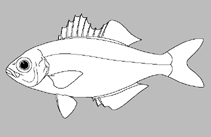
Épines dorsales (Total) : 10; Rayons mous dorsaux (Total) : 11 - 12; Épines anales: 3; Rayons mous anaux: 11 - 12. Preorbital serrae 11-20; body depth 2.6-3.1 in SL; maxilla ending beneath anterior third of eye; caudal concavity 2.0-2.4 in head length. Silvery, front of snout and chin a little blackish; naked part of caudal fin black with a large C-shaped, white marking basally in each lobe, the lobe tips white; outer part of anterior half of soft portion of dorsal fin broadly blackish (nearly half of first few rays and adjacent membranes blackish) (Ref. 41640).
Body shape (shape guide): fusiform / normal.
Feeds on zooplanktons (Ref. 89972).
Cycle de vie et comportement reproducteur
Maturité | Reproduction | Frai | Œufs | Fécondité | Larves
Randall, J.E. and H.A. Randall, 2001. Review of the fishes of the genus Kuhlia (Perciformes: Kuhliidae) of the Central Pacific. Pac. Sci. 55(3):227-256. (Ref. 41640)
Statut dans la liste rouge de l'IUCN (Ref. 130435: Version 2025-2 (Global))
Menace pour l'homme
Harmless
Utilisations par l'homme
Outils
Articles particuliers
Télécharger en XML
Sources Internet
Estimations basées sur des modèles
Température préférée (Réf.
123201): 27.7 - 29, mean 28.1 °C (based on 105 cells).
Indice de diversité phylogénétique (Réf.
82804): PD
50 = 0.5005 [Uniqueness, from 0.5 = low to 2.0 = high].
Bayesian length-weight: a=0.01413 (0.00597 - 0.03345), b=3.06 (2.86 - 3.26), in cm total length, based on LWR estimates for this (Sub)family-body shape (Ref.
93245).
Niveau trophique (Réf.
69278): 3.4 ±0.5 se; based on size and trophs of closest relatives
Résilience (Réf.
120179): Milieu, temps minimum de doublement de population : 1,4 à 4,4 années (Preliminary K or Fecundity.).
Vulnérabilité de la pêche (Ref.
59153): Low vulnerability (15 of 100).
🛈