>
Gobiiformes (Gobies) >
Microdesmidae (Wormfishes) > Ptereleotrinae
Etymology: Ptereleotris: Greek, pteron = wing, fin + The name of a Nile fish, eleotris (Ref. 45335); carinata: Name from Latin 'carina' for keel, 'carinata' meaning keeled; referring to the distinct membranous keel extending beneath the head.
Umwelt: Milieu / Klimazone / Tiefenbereich / Verbreitungsgebiet
Ökologie
seewasser demersal; tiefenbereich 12 - 25 m (Ref. 75966). Tropical
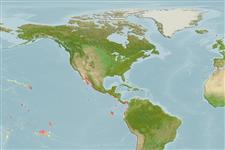
Eastern Pacific: Mexico (Gulf of California), Costa Rica and Panama.
Größe / Gewicht / Alter
Geschlechtsreife: Lm ? range ? - ? cm
Max length : 8.3 cm SL Männchen/unbestimmt; (Ref. 75996)
Kurzbeschreibung
Bestimmungsschlüssel | Morphologie | Morphometrie
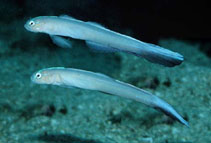
Rückenflossenstacheln (insgesamt) : 7; Rückenflossenweichstrahlen (insgesamt) : 20 - 22; Afterflossenstacheln: 1; Afterflossenweichstrahlen: 20 - 23. This species is distinguished from its congeners by the following characters: a short dorsal-fin (VI-I,20-22), first and second dorsal fins of about equal height; short anal-fin (I,19-22);isthmus with a conspicuous median fold or keel; caudal fin lanceolate with a dusky band on lower caudal rays in adults; a blue or lavender body without other markings (Ref. 75966).
The western Atlantic form, Ptereleotris calliurus, is similar to P. carinata in its more lanceolate tail with dark lower half, but differs from P. carinata in having a variety of other fin markings (vs. absent).
Cross section: oval.
Individuals were seen poised 10-20 cm above small mounds encircling the small openings to their burrows. It was also observed in burrows always close to a reef or grouped in small colonies on gently sloping mud-sand bottoms usually hundreds of meters from any rocky substrata. Juveniles were collected with quinaldine from the same burrows as adults they darted into. Often two adults or an adult and one or two juveniles were seen to occupy the same burrow. Individuals when prevented from entering their own burrow, would sometimes swim away rather than enter neighboring burrows (Ref. 75966).
Lebenszyklus und Paarungsverhalten
Geschlechtsreife | Fortpflanzung | Ablaichen | Eier | Fruchtbarkeit | Larven
Bussing, W.A., 2001. Ptereleotris carinata, a new species of hovering goby (Perciformes: Microdesmidae) from the tropical eastern Pacific. Rev. Biol. Trop. 49(Supl. 1):133-139,. (Ref. 75996)
IUCN Rote Liste Status (Ref. 130435: Version 2025-2 (Global))
Bedrohung für Menschen
Harmless
Nutzung durch Menschen
Tools
Zusatzinformationen
Download XML
Internet Quellen
Schätzungen auf der Grundlage von Modellen
Bevorzugte Temperatur (Ref.
123201): 24.2 - 29.1, mean 27.9 °C (based on 109 cells).
Phylogenetischer Diversitätsindex (Ref.
82804): PD
50 = 0.5000 [Uniqueness, from 0.5 = low to 2.0 = high].
Bayesian length-weight: a=0.00389 (0.00180 - 0.00842), b=3.12 (2.94 - 3.30), in cm total length, based on all LWR estimates for this body shape (Ref.
93245).
Trophische Ebene (Ref.
69278): 3.3 ±0.4 se; based on size and trophs of closest relatives
Anfälligkeit der Fischerei (Ref.
59153): Low vulnerability (10 of 100).
🛈