Klassifizierung / Names
Namen | Synonyme | Catalog of Fishes(Gattung, Arten) | ITIS | CoL | WoRMS | Cloffa
>
Tetraodontiformes (Puffers and filefishes) >
Monacanthidae (Filefishes)
Etymology: Enigmacanthus: Latin, aenigma = to speak allusively or obscurely + Greek, akantha = thorn; filamentosus: Named in reference to its filamentous second ray in the male's soft dorsal fin (Ref. 48594).
Umwelt: Milieu / Klimazone / Tiefenbereich / Verbreitungsgebiet
Ökologie
seewasser demersal; tiefenbereich 36 - 67 m (Ref. 48594). Tropical
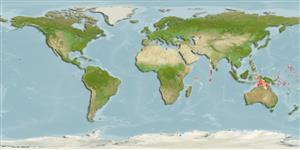
Indo-West Pacific: Seychelles and the Marshall Islands. Probably more widespread in insular areas.
Größe / Gewicht / Alter
Geschlechtsreife: Lm ? range ? - ? cm
Max length : 3.6 cm SL Männchen/unbestimmt; (Ref. 48594); 2.7 cm SL (female)
Kurzbeschreibung
Bestimmungsschlüssel | Morphologie | Morphometrie
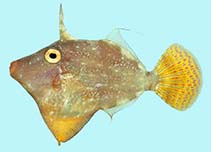
Rückenflossenstacheln (insgesamt) : 1; Rückenflossenweichstrahlen (insgesamt) : 27 - 28; Afterflossenstacheln: 0; Afterflossenweichstrahlen: 26; Wirbelzahl: 19. Maximum known size small (3.6 cm SL); soft Doral rays 27-28; anal rays 26; pectoral rays 11/11; dorsal profile of snout straight in male, slightly concave in female, without prominent hump just before nostrils; soft dorsal and anal fins not elevated anteriorly, outer margins convex; soft dorsal fin of male with second ray elongate and filamentous; caudal fin moderately long (about equal to head length), posterior margin convex; pelvis capable of moving vertically through an arc of about 40 degrees, producing a moderately large ventral flap; lobe on rear of pelvis small, directed dorsoposteriorly; pelvic fin rudiment relatively short and small, posterior segment movably articulated with pelvis; midbody scales each with up to six minute spinules located on a transverse ridge, those on caudal peduncle of male slightly longer, recurved, forming a poorly defined patch of bristles (Ref. 48594).
Body shape (shape guide): short and / or deep.
Inhabits sandy bottoms, possibly in areas with scattered coral clumps (Ref. 48594).
Lebenszyklus und Paarungsverhalten
Geschlechtsreife | Fortpflanzung | Ablaichen | Eier | Fruchtbarkeit | Larven
Hutchins, J.B., 2002. Description of a new genus and species of miniature monacanthid fish from the Seychelles and Marshall Islands. Rec. West. Aus. Mus. 21(2):213-219. (Ref. 48594)
IUCN Rote Liste Status (Ref. 130435: Version 2025-2 (Global))
Bedrohung für Menschen
Harmless
Nutzung durch Menschen
Tools
Zusatzinformationen
Download XML
Internet Quellen
Schätzungen auf der Grundlage von Modellen
Bevorzugte Temperatur (Ref.
123201): 15.3 - 28.6, mean 25.9 °C (based on 15 cells).
Phylogenetischer Diversitätsindex (Ref.
82804): PD
50 = 1.0000 [Uniqueness, from 0.5 = low to 2.0 = high].
Bayesian length-weight: a=0.01905 (0.00905 - 0.04012), b=2.93 (2.75 - 3.11), in cm total length, based on LWR estimates for this (Sub)family-body shape (Ref.
93245).
Trophische Ebene (Ref.
69278): 3.0 ±0.4 se; based on size and trophs of closest relatives
Widerstandsfähigkeit (Ref.
120179): hoch, Verdopplung der Population dauert weniger als 15 Monate. (Preliminary K or Fecundity.).
Anfälligkeit der Fischerei (Ref.
59153): Low vulnerability (10 of 100).
🛈