Élasmobranches (requins et raies) (sharks and rays) >
Torpediniformes (Electric rays) >
Narcinidae (Numbfishes)
Etymology: Narcine: Greek, narke = numbness (Ref. 45335); insolita: Name from Latin 'insolitus' meaning unusual or uncommon; referring to the unusual and unique disparate dimensions of the dorsal fins, treated as an adjective (feminine).
Environnement : milieu / zone climatique / profondeur / gamme de distribution
Écologie
marin démersal; profondeur 150 - 175 m (Ref. 93929). Tropical; 15°S - 25°S, 42°E - 45°E (Ref. 114953)
Western Indian Ocean: Madagascar.
Longueur à la première maturité / Taille / Poids / Âge
Maturité: Lm ? range ? - 35.6 cm
Max length : 35.6 cm TL (female)
Description synthétique
Clés d'identification | Morphologie | Morphométrie
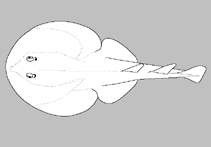
Vertèbres: 119 - 127. This species is distinguished from all its congeners by the following characters: unique presence of a very large and prominent first dorsal fin that is conspicuously taller, larger and with a longer base than the second dorsal fin; large spiracles, conspicuously rounded, not projecting anteriorly lateral to eyes, and with elevated rims all around; interspiracular distance much smaller than interorbital distance; small, broadly rounded lateral cusplets adjacent to principal cusp on teeth of more concealed inner rows; upper and lower tooth bands equal in width and broadly circular in outline; dorsal colouration composed of a yellowish brown background with darker brown to reddish brown irregular blotches on disc margins, posterior disc and anterior margin of snout; darker brown blotches on anterior portion of dorsal and caudal fins, at caudal apex, and laterally on tail at level of dorsal fins; precaudal vertebrae 68-71; total vertebrae 119-127 (Ref. 93929).
Body shape (shape guide): other; Cross section: flattened.
Usually found over predominantly muddy substrata (Ref. 93929). Maturity size of males at ca. 27 cm TL; birth size at ca. 14 cm TL (Ref. 114953).
Cycle de vie et comportement reproducteur
Maturité | Reproduction | Frai | Œufs | Fécondité | Larves
de Carvalho, M.R., B. Séret and L.J.V. Compagno, 2002. A new species of electric ray of the genus Narcine Henle, 1834 from the South-western Indian Ocean (Chondrichthyes: Torpediniformes: Narcinidae). S. Afr. J. mar. Sci. 24:135-149. (Ref. 93929)
Statut dans la liste rouge de l'IUCN (Ref. 130435: Version 2025-2 (Global))
Menace pour l'homme
Harmless
Utilisations par l'homme
Outils
Articles particuliers
Télécharger en XML
Sources Internet
Estimations basées sur des modèles
Indice de diversité phylogénétique (Réf.
82804): PD
50 = 0.5000 [Uniqueness, from 0.5 = low to 2.0 = high].
Bayesian length-weight: a=0.01175 (0.00470 - 0.02937), b=2.88 (2.66 - 3.10), in cm total length, based on LWR estimates for this (Sub)family-body shape (Ref.
93245).
Niveau trophique (Réf.
69278): 3.1 ±0.3 se; based on size and trophs of closest relatives
Résilience (Réf.
120179): Faible, temps minimum de doublement de population : 4,5 à 14 années (Assuming fecundity<100).
Vulnérabilité de la pêche (Ref.
59153): Low to moderate vulnerability (26 of 100).
🛈