>
Mulliformes (Goatfishes) >
Mullidae (Goatfishes)
Etymology: Parupeneus: Latin, parum, parvum = small + Peneus, the name of a river.
More on author: Valenciennes.
Taxonomic Remarks
FishBase common name changed from Two-banded goatfish to Triplebar goatfish (Uiblein et al., 2024: Ref. 130857).
Milieu: milieu / Klimaatzone / Diepte / verspreidingsgebied
Ecologie
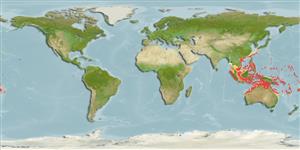
marien rifbewoner; diepte 1 - 80 m (Ref. 90102). Tropical; 32°N - 28°S, 95°E - 173°W
Indo-West Pacific: eastern Indian Ocean and the western Pacific east to Fiji, Tonga, and the Caroline Islands. This species is included in the Parupeneus trifasciatus complex where Parupeneus trifasciatus is restricted to the Indian Ocean and Parupeneus insularis from the Hawaiian Islands, French Polynesia, and Pitcairn Islands to the Marshalls, Mariana, Phoenix, and Samoa Islands.
Grootte / Gewicht / Leeftijd
Maturiteit: Lm ? range ? - ? cm
Max length : 38.0 cm TL mannelijk / geslacht onbekend; (Ref. 90102)
Korte beschrijving
Determinatiesleutels | Morfologie | Morfometrie
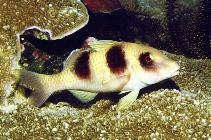
Dorsale stekels (totaal) : 8; Dorsale zachte stralen (totaal) : 9; Anale stekels: 1; Anale zachte stralen: 7. Diagnosis: Pectoral rays 15-16 (rarely 15). Gill rakers 7-10 + 27-31 (total 35-40). Body depth 2.653.1 in SL (deeper body with growth); head length (HL) 2.8-3.15 in SL; snout length 1.75-1.95 in HL; barbels short, 1.45-1.75 in HL; longest dorsal spine 1.4-1.6 in HL; penultimate dorsal ray 1.2-1.5 in length of last dorsal ray; pectoral-fin length 1.25-1.45 in HL; pelvic-fin length 1.2-1.4 in HL. Color white, the scale edges yellow or yellowish gray, the posterior edge often enlarged to a distinct yellow spot; upper two-thirds of body with two very large oval black spots, the first centered below anterior spines of first dorsal fin and the second below anterior half or more of second dorsal fin and extending into basal part of fin; a large black spot on head behind and enclosing part of eye, extending diffusely toward comer of mouth; broad outer part of second dorsal and anal fins blue with narrow oblique dark-edged yellow bands; caudal fin streaked with dull blue and yellow; inner rim of iris bright red (Ref. 54393).
Body shape (shape guide): fusiform / normal.
Coastal to outer reef habitats. Juveniles usually in shallow surge channels on reef slopes adjacent to drop-offs. Adults usually seen resting on corals on reef crests (Ref. 48636).
Levenscyclus en paargedrag
Maturiteit | Voortplanting | Paaien | Eieren | Fecunditeit | Larven
Randall, J.E., 2004. Revision of the goatfish genus Parupeneus (Perciformes: Mullidae), with descriptions of two new species. Indo-Pac. Fish. (36):64 p. (Ref. 54393)
Status op de Rode Lijst van het IUCN (Ref. 130435: Version 2025-2 (Global))
Gevaar voor de mens
Harmless
Gebruik door de mens
Visserij: commercieel
Tools
Speciale rapporten
Download XML
Internetbronnen
Schattingen op basis van modellen
Gewenste temperatuur (Ref.
123201): 25.3 - 28.9, mean 27.7 °C (based on 350 cells).
Fylogenetische diversiteitsindex (Ref.
82804): PD
50 = 0.5000 [Uniqueness, from 0.5 = low to 2.0 = high].
Bayesian length-weight: a=0.01175 (0.00543 - 0.02542), b=3.09 (2.92 - 3.26), in cm total length, based on LWR estimates for this Genus-body shape (Ref.
93245).
Trofisch niveau (Ref.
69278): 3.6 ±0.3 se; based on diet studies.
Weerstandsvermogen (Ref.
120179): Gemiddeld, minimale populatieverdubbelingstijd 1,4-4,4 jaar (Preliminary K or Fecundity.).
Kwetsbaarheid van de visserij (Ref.
59153): Low to moderate vulnerability (28 of 100).
🛈
Voedingsstoffen (Ref.
124155): Calcium = 30.9 [15.6, 68.7] mg/100g; Iron = 0.297 [0.150, 0.656] mg/100g; Protein = 17.9 [14.6, 20.9] %; Omega3 = 0.127 [0.073, 0.229] g/100g; Selenium = 56.3 [27.5, 127.7] μg/100g; VitaminA = 195 [40, 801] μg/100g; Zinc = 0.512 [0.307, 0.976] mg/100g (wet weight);