>
Gobiiformes (Gobies) >
Gobiidae (Gobies) > Gobiinae
Etymology: Lobulogobius: Latin, lobulus = lobe + Latin, gobius = gudgeon (Ref. 45335); morrigu: Morrigu: the old Irish war goddess, in reference to the jaws and dentition (Ref. 11432).
Eponymy: Morrigu, or The Morrigan (thought to mean ‘Phantom Queen’), is a war goddess in old Irish mythology. The name was given “in reference to the jaws and dentition” of this goby, which has several rows of sharp, pointed teeth. (Ref. 128868), visit book page.
More on author: Larson.
Ambiente: milieu / zona climatica / distribuzione batimetrica / gamma di distribuzione
Ecologia
marino demersale; distribuzione batimetrica 28 - 72 m (Ref. 11432). Tropical
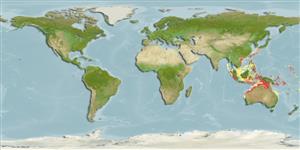
Western Central Pacific: Arafura Sea.
Dimensione / Peso / Età
Maturità: Lm ? range ? - ? cm
Max length : 3.1 cm SL maschio/sesso non determinato; (Ref. 11432)
Breve descrizione
Chiavi di identificazione | Morfologia | Morfometria
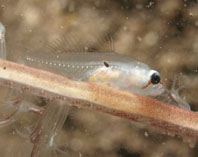
Spine dorsali (totale) : 7; Raggi dorsali molli (totale) : 8; Spine anali: 1; Raggi anali molli: 9. Compressed head and body, and rather small eyes and sculpturing on the angle of the preopercle. Pelvic fins fused to form rounded cup, and frenum folded forming an anteriorly-facing pocket. Head and nape without scales. Eyes set laterally and high on head. Interorbital wide, about twice eye diameter. Mouth anterior and oblique, with several rows of curved pointed teeth. Tongue blunt or bilobed. Gill opening wide, gill membranes free of isthmus and each other until they meet as isthmus at a point below the eye. Unpaired fins low. Pectoral rays 19, branched in adults (Ref. 11432).
Body shape (shape guide): elongated; Cross section: compressed.
Commensal in sponges and gorgonians (Ref. 11432, 48637).Commensal with sea pens and hollow, banching gorgonians (genus Solenocaulon) (Ref 90102).
Ciclo vitale e comportamento di accoppiamento
Maturità | Riproduzione | Deposizione | Uova | Fecondità | Larve
Larson, H.K. and E.O. Murdy, 2001. Gobiidae. Gobies. p. 3578-3603. In K.E. Carpenter and V. Niem (eds.) FAO species identification guide for fishery purposes. The living marine resources of the Western Central Pacific. Vol. 6. Bony fishes part 4 (Labridae to Latimeriidae), estuarine crocodiles. FAO, Rome. (Ref. 42915)
Stato della Lista Rossa IUCN (Ref. 130435: Version 2025-2 (Global))
Minaccia per l'uomo
Harmless
Usi umani
Strumenti
Rapporti speciali
Scarica XML
Fonti Internet
Stime basate su modelli
Temperatura preferita (Fonte Biblio.
123201): 24.7 - 28.3, mean 27.4 °C (based on 110 cells).
Indice di diversità filogenetica (Fonte Biblio.
82804): PD
50 = 0.6250 [Uniqueness, from 0.5 = low to 2.0 = high].
Bayesian length-weight: a=0.00741 (0.00347 - 0.01582), b=3.09 (2.91 - 3.27), in cm total length, based on LWR estimates for this (Sub)family-body shape (Ref.
93245).
Livello trofico (Fonte Biblio.
69278): 3.1 ±0.3 se; based on size and trophs of closest relatives
Resilienza (Fonte Biblio.
120179): Alto, tempo minimo di raddoppiamento della popolazione meno di 15 mesi (Preliminary K or Fecundity.).
Vulnerabilità della pesca (Ref.
59153): Low vulnerability (10 of 100).
🛈