Klassificering / Namn
Populärnamn | synonymer | Catalog of Fishes(Släkte, Arter) | ITIS | CoL | WoRMS | Cloffa
>
Ovalentaria/misc (Various families in series Ovalentaria) >
Pomacentridae (Damselfishes) > Pomacentrinae
Etymology: Amblyglyphidodon: Greek, amblys = darkness + Greek, glyphis = carved + Greek, odous = teeth (Ref. 45335); melanopterus: Name from Greek 'melanos' for black and 'pteron' for fin; referring to the black caudal fin and soft portions of the dorsal and anal fins.
More on authors: Allen & Randall.
Miljö: miljö / Klimatzon / djupintervall / distributionsområde
Ekologi
marina revassocierade; djupintervall 2 - 8 m (Ref. 82240). Tropical
Utbredning
Territorier | FAO områden | Ekosystem | Förekomster | Prickkarta | Utplanteringar | Faunafri
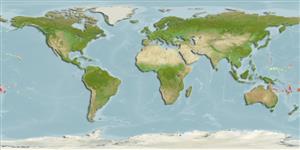
Pacific Ocean: known only from Tonga.
Storlek / Vikt / Ålder
Könsmognad: Lm ? range ? - ? cm
Max length : 10.2 cm SL hane/ej könsbestämd; (Ref. 82240)
Kort beskrivning
Bestämningsnycklar | Morfologi | Morfometri
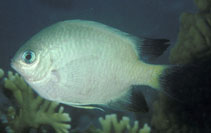
Taggstrålar i ryggfenan (totalt) : 7 - 8; Mjukstrålar i ryggfenan (totalt) : 11 - 13; Taggstrålar i analfenan: 2; Mjukstrålar i analfenan: 11 - 13; Ryggkotor: 26. This species is distinguished by the following characters: D XII-XIII (rarely XII),11-13; A II,11-13; pectoral rays 16-18; lateral line tubed scales 14-17 (modally 16); gill rakers 8-9 + 22-24 (total, 30-33, modally 31-32); body depth is 1.65-1.8 in SL; teeth are incisiform, in a single row; scaled suborbital; scales dorsally on snout extending well before nostrils, nearly to base of upper lip; colour of dorsal part of head, anterior body and scaled basal part of dorsal fin is light greyish green, scale edges are dusky, shading ventrally and posteriorly to greenish or pinkish white; naked portion of caudal fin and soft portions of dorsal and anal fins are black; pectoral fins with transparent membranes and faintly dusky rays; without black spot at base or axil of pectoral fins; pelvic fins are white (Ref. 82240).
Body shape (shape guide): short and / or deep; Cross section: compressed.
Presumed to be reef-associated (Ref. 46206). Oviparous, distinct pairing during breeding (Ref. 205). Eggs are demersal and adhere to the substrate (Ref. 205). Males guard and aerate the eggs (Ref. 205).
Livscykel och parningsbeteende
Könsmognad | Reproduktion | Lek | Ägg | Fekunditet | Larver
Oviparous, distinct pairing during breeding (Ref. 205). Eggs are demersal and adhere to the substrate (Ref. 205). Males guard and aerate the eggs (Ref. 205).
Allen, G.R. and J.E. Randall, 2002. A review of the leucogaster species complex of the Indo-Pacific pomacentrid genus Amblyglyphidodon, with descriptions of two new species. aqua, J. Ichthyol. Aquat. Biol. 5(4):139-152. (Ref. 82240)
Status på IUCN:s rödlista (Ref. 130435: Version 2025-2 (Global))
Hot mot människor
Harmless
Mänskliga användningsområden
Verktyg
Särskilda rapporter
Ladda ner XML
Internet-källor
Uppskattningar baserade på modeller
Önskad temperatur (Ref.
123201): 24.9 - 29.2, mean 27.1 °C (based on 163 cells).
Index för fylogenetisk mångfald (Ref.
82804): PD
50 = 0.5005 [Uniqueness, from 0.5 = low to 2.0 = high].
Bayesian length-weight: a=0.02344 (0.01149 - 0.04783), b=2.98 (2.80 - 3.16), in cm total length, based on LWR estimates for this (Sub)family-body shape (Ref.
93245).
Trofisk nivå (Ref.
69278): 2.7 ±0.3 se; based on size and trophs of closest relatives
Resiliens (Ref.
120179): Hög, lägsta populationsfördubblingstid mindre än 15 månader (Preliminary K or Fecundity.).
Sårbarhet i fisket (Ref.
59153): Low vulnerability (10 of 100).
🛈
Näringsämnen (Ref.
124155): Calcium = 123 [61, 196] mg/100g; Iron = 0.767 [0.454, 1.301] mg/100g; Protein = 18.2 [17.0, 19.3] %; Omega3 = 0.101 [0.058, 0.169] g/100g; Selenium = 17.8 [9.7, 34.9] μg/100g; VitaminA = 97.4 [26.9, 337.0] μg/100g; Zinc = 1.9 [1.3, 2.8] mg/100g (wet weight);