>
Ovalentaria/misc (Various families in series Ovalentaria) >
Pomacentridae (Damselfishes) > Pomacentrinae
Etymology: Amblyglyphidodon: Greek, amblys = darkness + Greek, glyphis = carved + Greek, odous = teeth (Ref. 45335).
Milieu: milieu / Klimaatzone / Diepte / verspreidingsgebied
Ecologie
marien demersaal; diepte ? - 30 m (Ref. 86942). Tropical
Pacific Ocean: Samoa, Fiji, and New Caledonia (Ref. 82240); also in Tonga (Ref. 53797).
Grootte / Gewicht / Leeftijd
Maturiteit: Lm ? range ? - ? cm
Max length : 8.3 cm SL mannelijk / geslacht onbekend; (Ref. 28618)
Korte beschrijving
Determinatiesleutels | Morfologie | Morfometrie
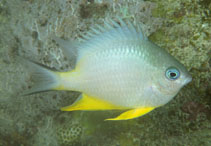
Dorsale stekels (totaal) : 8; Dorsale zachte stralen (totaal) : 12 - 13; Anale stekels: 2; Anale zachte stralen: 12 - 14. This species is distinguished by the following characters: D XIII,12-13; A II,12-14; pectoral rays 17; tubed lateral line scales 14-17 (modally 15-16); total gill rakers 28-31; scaled suborbital; body depth 1.6-1.7 in SL; colouration of head and nape grey, body silvery white, suffused with yellow, becoming more yellow ventrally and posteriorly; dorsal fin is grey without black markings; anal and pelvic fins are yellow to yellowish grey; caudal fin have whitish rays and transparent membranes, the upper and lower edges are narrowly black to blackish; upper edge of pectoral fin base with a very small black spot (Ref. 82240).
Body shape (shape guide): short and / or deep; Cross section: compressed.
Oviparous, distinct pairing during breeding (Ref. 205). Eggs are demersal and adhere to the substrate (Ref. 205). Males guard and aerate the eggs (Ref. 205).
Levenscyclus en paargedrag
Maturiteit | Voortplanting | Paaien | Eieren | Fecunditeit | Larven
Oviparous, distinct pairing during breeding (Ref. 205). Eggs are demersal and adhere to the substrate (Ref. 205). Males guard and aerate the eggs (Ref. 205).
Allen, G.R. and J.E. Randall, 2002. A review of the leucogaster species complex of the Indo-Pacific pomacentrid genus Amblyglyphidodon, with descriptions of two new species. aqua, J. Ichthyol. Aquat. Biol. 5(4):139-152. (Ref. 82240)
Status op de Rode Lijst van het IUCN (Ref. 130435: Version 2025-2 (Global))
Gevaar voor de mens
Harmless
Gebruik door de mens
Tools
Speciale rapporten
Download XML
Internetbronnen
Schattingen op basis van modellen
Fylogenetische diversiteitsindex (Ref.
82804): PD
50 = 0.5005 [Uniqueness, from 0.5 = low to 2.0 = high].
Bayesian length-weight: a=0.02344 (0.01149 - 0.04783), b=2.98 (2.80 - 3.16), in cm total length, based on LWR estimates for this (Sub)family-body shape (Ref.
93245).
Trofisch niveau (Ref.
69278): 2.7 ±0.3 se; based on size and trophs of closest relatives
Weerstandsvermogen (Ref.
120179): Hoog, minimale populatieverdubbelingstijd minder dan 15 maanden (Preliminary K or Fecundity.).
Kwetsbaarheid van de visserij (Ref.
59153): Low vulnerability (10 of 100).
🛈
Voedingsstoffen (Ref.
124155): Calcium = 366 [210, 684] mg/100g; Iron = 1.6 [0.8, 2.7] mg/100g; Protein = 17.3 [16.3, 18.3] %; Omega3 = 0.192 [0.104, 0.360] g/100g; Selenium = 36.5 [18.3, 74.2] μg/100g; VitaminA = 26.8 [8.3, 88.0] μg/100g; Zinc = 1.96 [1.32, 2.87] mg/100g (wet weight);