Classification / Noms
Noms communs | Synonymes | Catalog of Fishes(Genre, Espèce) | ITIS | CoL | WoRMS | Cloffa
>
Stomiiformes (Lightfishes and dragonfishes) >
Stomiidae (Barbeled dragonfishes) > Melanostomiinae
Etymology: Eustomias: Greek, eu = good + Greek, stoma = mouth (Ref. 45335); elongatus: Named in reference to its elongate terminal bulb as well as fact that this species has the relatively longest barbel among known species of Dinematochirus (Ref. 45801).
Environnement : milieu / zone climatique / profondeur / gamme de distribution
Écologie
marin bathypélagique; profondeur 0 - 370 m (Ref. 45801). Deep-water
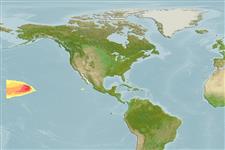
Eastern Central Pacific: near Hawaii and two stations to the west.
Taille / Poids / Âge
Maturité: Lm ? range ? - ? cm
Max length : 13.4 cm SL (female)
Description synthétique
Clés d'identification | Morphologie | Morphométrie
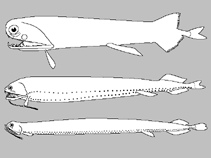
BL greater than 20% SL; barbel with five similar branches apparently arising together from main stem (lateral pair actually arising from bases of medio-lateral pair); stem solidly pigmented, pigment extending onto dorsal side of terminal bulb; bulb elongate, only slightly thicker than stem, with an unpigmented tip usually directed dorsad; terminal filament absent or single and minute, arising from ventral side of bulb tip (Ref. 45801).
Body shape (shape guide): elongated.
Epi- and mesopelagic (Ref. 58302).
Cycle de vie et comportement reproducteur
Maturité | Reproduction | Frai | Œufs | Fécondité | Larves
Clarke, T.A., 2001. Pelagic fishes of the genus Eustomias, subgenus Dinematochirus (Stomiidae), in the Indo-Pacific with the description of twelve new speices. Copeia 2001(3):683-699. (Ref. 45801)
Statut dans la liste rouge de l'IUCN (Ref. 130435: Version 2025-2 (Global))
Menace pour l'homme
Harmless
Utilisations par l'homme
Pêcheries: sans intérêt
Outils
Articles particuliers
Télécharger en XML
Sources Internet
Estimations basées sur des modèles
Température préférée (Réf.
123201): 9.3 - 15.3, mean 15.1 °C (based on 3 cells).
Indice de diversité phylogénétique (Réf.
82804): PD
50 = 0.5000 [Uniqueness, from 0.5 = low to 2.0 = high].
Bayesian length-weight: a=0.00302 (0.00115 - 0.00790), b=3.11 (2.88 - 3.34), in cm total length, based on LWR estimates for this (Sub)family-body shape (Ref.
93245).
Niveau trophique (Réf.
69278): 4.2 ±0.8 se; based on size and trophs of closest relatives
Résilience (Réf.
120179): Haut, temps minimum de doublement de population inférieur à 15 mois (Preliminary K or Fecundity.).
Vulnérabilité de la pêche (Ref.
59153): Low vulnerability (10 of 100).
🛈