Élasmobranches (requins et raies) (sharks and rays) >
Torpediniformes (Electric rays) >
Torpedinidae (Electric rays)
Etymology: Torpedo: Latin, torpere = be sluggish (Ref. 45335); adenensis: Named for its type locality, the Gulf of Aden; an adjective.
Environnement : milieu / zone climatique / profondeur / gamme de distribution
Écologie
marin démersal; profondeur 125 - 230 m (Ref. 83892). Tropical; 14°N - 12°N, 47°E - 51°E (Ref. 114953)
Western Indian Ocean: Yemen, Gulf of Aden.
Longueur à la première maturité / Taille / Poids / Âge
Maturité: Lm 33.8, range 28 - 39.5 cm
Max length : 10.7 cm TL mâle / non sexé; (Ref. 83892); 39.0 cm TL (female)
Description synthétique
Clés d'identification | Morphologie | Morphométrie
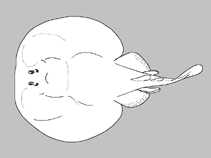
This species is distinguished from all congeners its unique dorsal coloration, uniform reddish-, rusty-, or orange-brown and no any distinctive spots, blotches, or reticulations. Further distinct in having the following characters: spiracles with few, knoblike, and somewhat inconspicuous spiracular papillae (at least in sexually mature or almost mature specimens); spiracles and eyes relatively close together (no large gap in between); base of first dorsal fin extending just posterior to level of pelvic fin axil (not entirely positioned over bases of pelvic fins); distance between second dorsal and caudal fin greater than distance between first and second dorsal fins; claspers with fleshy integumental flap in clasper glans region (Ref. 83892).
Body shape (shape guide): other.
Ovoviviparous (Ref. 50449). Poorly known. Maturity size of males reported at 39 cm TL, still adolescent at 28 cm TL (Ref. 114953).
Cycle de vie et comportement reproducteur
Maturité | Reproduction | Frai | Œufs | Fécondité | Larves
Exhibit ovoviparity (aplacental viviparity), with embryos feeding initially on yolk, then receiving additional nourishment from the mother by indirect absorption of uterine fluid enriched with mucus, fat or protein through specialised structures (Ref. 50449).
de Carvalho, M.R., M.F.W. Stehmann and L.G. Manilo, 2002. Torpedo adenensis, a new species of electric ray from the Gulf of Aden, with comments on nominal species of Torpedo from the western Indian Ocean, Arabian Sea, and adjacent areas (Chondrichthyes: Torpediniformes: Torpedinidae). Am. Mus. Novit. 3369:1-34. (Ref. 83892)
Statut dans la liste rouge de l'IUCN (Ref. 130435: Version 2025-2 (Global))
Menace pour l'homme
Harmless
Utilisations par l'homme
Outils
Articles particuliers
Télécharger en XML
Sources Internet
Estimations basées sur des modèles
Indice de diversité phylogénétique (Réf.
82804): PD
50 = 0.5005 [Uniqueness, from 0.5 = low to 2.0 = high].
Bayesian length-weight: a=0.01479 (0.00678 - 0.03229), b=2.97 (2.78 - 3.16), in cm total length, based on LWR estimates for this (Sub)family-body shape (Ref.
93245).
Niveau trophique (Réf.
69278): 4.2 ±0.7 se; based on size and trophs of closest relatives
Résilience (Réf.
120179): Faible, temps minimum de doublement de population : 4,5 à 14 années (Live bearer with low fecundity (RF)).
Vulnérabilité de la pêche (Ref.
59153): Low to moderate vulnerability (29 of 100).
🛈