Milieu: milieu / Klimaatzone / Diepte / verspreidingsgebied
Ecologie
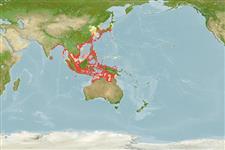
marien; zoet water; brak water pelagic-neritic; amfidroom (Ref. 51243); diepte 0 - 50 m (Ref. 189). Tropical; 42°N - 17°S, 81°E - 147°E (Ref. 189)
Eastern Indian Ocean: northern and eastern Bay of Bengal coasts, including the Andaman Islands; perhaps southward from the Godavari river. Western Pacific: northern coast of Australia, Arafura Sea (Ref. 9819), Gulf of Papua, Sarawak, presumably the Philippines and Hong Kong; China from Taiwan north to Yellow Sea and southern part of Sea of Japan.
Grootte / Gewicht / Leeftijd
Maturiteit: Lm ? range ? - ? cm
Max length : 22.0 cm SL mannelijk / geslacht onbekend; (Ref. 9822); max. gepubliceerd gewicht: 44.25 g (Ref. 124713)
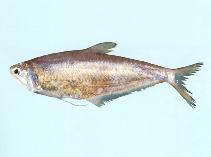
Dorsale stekels (totaal) : 0; Anale stekels: 0; Anale zachte stralen: 46 - 56. Belly with 18 to 20 (rarely 17 or 21) + 7 (sometimes 8) = 25 to 27 keeled scutes from isthmus to anus. Lower gill rakers with the serrae uneven, with slight or sometimes distinct clumps of larger serrae. Pectoral filament moderate, reaching back to base of 9th to 21st anal fin ray.
Body shape (shape guide): elongated; Cross section: compressed.
Presumably schooling and occurring mostly in coastal waters, but also entering estuaries (Ref. 11230) (e.g. the Hooghly and Godavari in India) and penetrating at least 20 km up the Godavari, tolerating salinities as low as 8.7 ppt. Feeds on prawn, copepods, crustacean larvae, mollusks and fishes. Fairly common (Ref. 189).
Levenscyclus en paargedrag
Maturiteit | Voortplanting | Paaien | Eieren | Fecunditeit | Larven
Wongratana, T., T.A. Munroe and M. Nizinski, 1999. Order Clupeiformes. Engraulidae. Anchovies. p. 1698-1753. In K.E. Carpenter and V.H. Niem (eds.) FAO species identification guide for fishery purposes. The living marine resources of the WCP. Vol. 3. Batoid fishes, chimaeras and bony fishes part 1 (Elopidae to Linophrynidae). FAO, Rome. (Ref. 9822)
Status op de Rode Lijst van het IUCN (Ref. 130435: Version 2025-2 (Global))
Gevaar voor de mens
Harmless
Gebruik door de mens
Visserij: van minder commercieel belang
Tools
Speciale rapporten
Download XML
Internetbronnen
Schattingen op basis van modellen
Gewenste temperatuur (Ref.
123201): 24.7 - 29.1, mean 28.4 °C (based on 948 cells).
Fylogenetische diversiteitsindex (Ref.
82804): PD
50 = 0.5039 [Uniqueness, from 0.5 = low to 2.0 = high].
Bayesian length-weight: a=0.00447 (0.00263 - 0.00757), b=3.10 (2.96 - 3.24), in cm total length, based on LWR estimates for this species & (Sub)family-body (Ref.
93245).
Trofisch niveau (Ref.
69278): 3.6 ±0.51 se; based on food items.
Weerstandsvermogen (Ref.
120179): Hoog, minimale populatieverdubbelingstijd minder dan 15 maanden (Preliminary K or Fecundity.).
Kwetsbaarheid van de visserij (Ref.
59153): Low vulnerability (17 of 100).
🛈