>
Blenniiformes (Blennies) >
Blenniidae (Combtooth blennies) > Salariinae
Etymology: Praealticus: Latin, prae = in front of + Latin, altus, alticus = nutritious.
Eponymy: Pieter van Oort (1804–1834) was a Dutch naturalist and collector in the East Indies (Indonesia). [...] (Ref. 128868), visit book page.
More on author: Bleeker.
Entorno: milieu / zona climática / rango de profundidad / gama de distribución
Ecología
marino demersal. Tropical
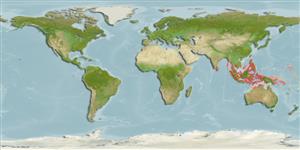
Western Central Pacific.
Tamaño / Peso / Edad
Madurez: Lm ? range ? - ? cm
Max length : 6.0 cm TL macho / no sexado; (Ref. 90102)
Descripción breve
Claves de identificación | Morfología | Morfometría
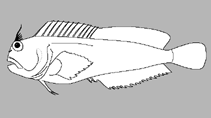
Espinas dorsales (total) : 13; Radios blandos dorsales (total) : 17 - 19; Espinas anales: 2; Radios blandos anales: 19 - 21. Color in life unknown. Preserved specimen with vertically elongate blotch behind eye; ca. 10 bifurcate bars on body and dark spots on anterior body. Dorsal fin deeply notched; segmented caudal rays typically 13-14, middle 2-8 (typically 5-8)branched; supraorbital tentacle pinnately branched; nape cirri absent; posterior rim of anterior nostril with small cirrus (typically unbranched); upper lip margin laterally crenulate; males with occipital crest; last dorsal ray and caudal peduncle connected by membrane; body elongate, depth at anal-fin origin ca. 7.0 in SL. Maximum length, 6 cm TL (Ref. 90102).
Facultative air-breathing (Ref. 126274); Adults inhabit rocky shores (Ref. 90102). Oviparous. Eggs are demersal and adhesive (Ref. 205), and are attached to the substrate via a filamentous, adhesive pad or pedestal (Ref. 94114). Larvae are planktonic, often found in shallow, coastal waters (Ref. 94114).
Ciclo vital y comportamiento de apareamiento
Madurez | Reproducción | Puesta | Huevos | Fecundidad | Larva
Oviparous, distinct pairing (Ref. 205).
Springer, V.G., 2001. Blennidae. Blennies (combtooth and sabertooth blennies). p. 3538-3546. In K.E. Carpenter and V. Niem (eds.) FAO species identification guide for fishery purposes. The living marine resources of the Western Central Pacific. Vol. 6. Bony fishes part 4 (Labridae to Latimeriidae), estuarine crocodiles. FAO, Rome. (Ref. 12848)
Situación en la Lista Roja de la UICN (Ref. 130435: Version 2025-2 (Global))
Amenaza para el ser humano
Harmless
Usos humanos
Herramientas
Informes especiales
Descargar XML
Fuentes de Internet
Estimaciones basadas en modelos
Temperatura preferida (Referencia
123201): 28.3 - 29.3, mean 28.8 °C (based on 1038 cells).
Índice de diversidad filogenética (Referencia
82804): PD
50 = 0.5001 [Uniqueness, from 0.5 = low to 2.0 = high].
Bayesian length-weight: a=0.00776 (0.00354 - 0.01702), b=3.00 (2.81 - 3.19), in cm total length, based on LWR estimates for this (Sub)family-body shape (Ref.
93245).
Nivel trófico (Referencia
69278): 2.0 ±0.00 se; based on food items.
Resiliencia (Referencia
120179): Alto, población duplicada en un tiempo mínimo inferior a 15 meses (Preliminary K or Fecundity.).
Vulnerabilidad pesquera (Ref.
59153): Low vulnerability (10 of 100).
🛈