Umwelt: Milieu / Klimazone / Tiefenbereich / Verbreitungsgebiet
Ökologie
seewasser riff-verbunden. Tropical
Western Central Pacific. Eastern Central Pacific: Marquesan Islands (Ref. 41656).
Größe / Gewicht / Alter
Geschlechtsreife: Lm ? range ? - ? cm
Max length : 12.0 cm SL Männchen/unbestimmt; (Ref. 54980)
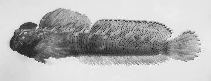
Rückenflossenstacheln (insgesamt) : 13; Rückenflossenweichstrahlen (insgesamt) : 23 - 24; Afterflossenstacheln: 2; Afterflossenweichstrahlen: 26. Freely movable teeth around 300 in upper jaw and 250 in lower jaw; crenulate lip margins; absence of fleshy disc behind lower lip; short and unbranched supraorbital cirrus; absence of nuchal cirri; males with fleshy occipital crest; body depth at origin of anal fin ca 7-8 SL; deep notch between spinous and soft ray portions of dorsal fin, the last ray joined by membrane to caudal peduncle; last anal ray and peduncle not bound by membrane; male coloration gray-brown, ventrally blending to white, with white vertical rows of white striations reaching dorsal fin parallel with spines and rays; a series of small, dark brown spots running along the back and continuing into dorsal-fin base; head finely dotted with white, turning white on branchiostegal membranes; a curving black line behind eye; cheek with 2 small black spots; caudal and soft dorsal ray tips white. Dorsal rays XIII, 23-24; 13 unbranched caudal rays (Ref. 54980).
Body shape (shape guide): elongated.
Facultative air-breathing (Ref. 126274); Found in surge-zone (Ref. 54980). Oviparous. Eggs are demersal and adhesive (Ref. 205), and are attached to the substrate via a filamentous, adhesive pad or pedestal (Ref. 94114). Larvae are planktonic, often found in shallow, coastal waters (Ref. 94114). Feeds on filamentous algae (Ref. 89972).
Lebenszyklus und Paarungsverhalten
Geschlechtsreife | Fortpflanzung | Ablaichen | Eier | Fruchtbarkeit | Larven
Oviparous, distinct pairing (Ref. 205).
Springer, V.G., 2001. Blennidae. Blennies (combtooth and sabertooth blennies). p. 3538-3546. In K.E. Carpenter and V. Niem (eds.) FAO species identification guide for fishery purposes. The living marine resources of the Western Central Pacific. Vol. 6. Bony fishes part 4 (Labridae to Latimeriidae), estuarine crocodiles. FAO, Rome. (Ref. 12848)
IUCN Rote Liste Status (Ref. 130435: Version 2025-2 (Global))
Bedrohung für Menschen
Harmless
Nutzung durch Menschen
Tools
Zusatzinformationen
Download XML
Internet Quellen
Schätzungen auf der Grundlage von Modellen
Phylogenetischer Diversitätsindex (Ref.
82804): PD
50 = 0.5020 [Uniqueness, from 0.5 = low to 2.0 = high].
Bayesian length-weight: a=0.00776 (0.00354 - 0.01702), b=3.00 (2.81 - 3.19), in cm total length, based on LWR estimates for this (Sub)family-body shape (Ref.
93245).
Trophische Ebene (Ref.
69278): 2.0 ±0.00 se; based on food items.
Widerstandsfähigkeit (Ref.
120179): hoch, Verdopplung der Population dauert weniger als 15 Monate. (Preliminary K or Fecundity.).
Anfälligkeit der Fischerei (Ref.
59153): Low vulnerability (10 of 100).
🛈