Классификация / Имена
народные названия | синонимы | Catalog of Fishes(род, виды) | ITIS | CoL | WoRMS | Cloffa
>
Characiformes (Characins) >
Characidae (Characins; tetras) > Cheirodontinae
Etymology: Odontostilbe: Greek, odous = teeth + Greek, stilbe, es = lamp (Ref. 45335).
More on author: Gill.
Окружающая среда: среда / климатическая зона / пределы глубины / диапазон распространения
экология
; пресноводный донно-пелагический. Tropical
Central America: Trinidad Island in Trinidad and Tobago; widespread in río Orinoco basin, smaller coastal drainages of Venezuela, Lake Valencia system and the rio Essequibo basin. A spot occurrence in the upper rio Demini, rio Negro, Amazonas basin, though represented by a unique mature male.
Размер / Вес / Возраст
половая зрелость: Lm ? range ? - ? cm
Max length : 3.7 cm SL самец/пол неопределен; (Ref. 75063); 3.7 cm SL (female)
Краткое описание
определительные ключи | морфология | морфометрия
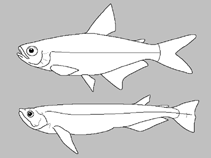
членистые (мягкие) лучи спинного плавника (общее число) : 11. Distinguished from most other members of the genus Odontostilbe by having a remarkably long anal-fin base 26.0-33.5% SL, with only Odontostilbe nareuda has a similarly long anal-fin base length 31.3-32.8% SL, but can be differentiated from Odontostilbe pulchra in having anal-fin rays 24-26 (vs. 17-24, usually 19-22 in Odontostilbe pulchra). In addition, mature males of Odontostilbe pulchra differ from Odontostilbe fugitiva, Odontostilbe ecuadorensis, Odontostilbe dierythrura, Odontostilbe parecis, Odontostilbe paraguayensis, Odontostilbe microcephala, Odontostilbe splendida, and Odontostilbe pao by possessing hooks on the 1st to 22nd anal-fin branched rays of males, practically
on all branched anal-fin rays (vs. 1st to 9th, mostly 6th-7th, anal-fin branched rays of males with hooks); distal border of anal fin slightly concave to almost straight in mature males (vs. distal border concave); longer pectoral fin passing a vertical through pelvic-fin origin (vs. shorter pectoral fin reaching but not trespassing to vertical through pelvic-fin origin), almost absence of elongation of the 2nd unbranched dorsal-fin ray (vs. noticeably elongate 2nd unbranched dorsal-fin ray). Furthermore, males, females and unsexed specimens differ from
Odontostilbe fugitiva by having longer upper jaw 26.8-32.5% HL (vs. 23.4-30.0% HL). The snout length in males separates Odontostilbe pulchra (18.0-26.0% HL, mean 21.8%) from the sympatric species Odontostilbe splendida with 24.1-26.9% HL, mean 25.2% HL, and Odontostilbe pao with 26.7-30.6 HL, mean 28.6% HL (Ref. 75063).
Body shape (shape guide): elongated; Cross section: compressed.
Жизненный цикл и брачное поведение
половая зрелость | размножение | нерест | икра | Плодовитость | личинки
Bührnheim, C.M. and L.R. Malabarba, 2007. Redescription of Odontostilbe pulchra (Gill, 1858) (Teleostei: Characidae: Cheirodontinae), and description of two new species from the río Orinoco basin. Neotrop. Ichthyol. 5(1):1-20. (Ref. 75063)
Статус Красного Списка МСОП (Ref. 130435: Version 2025-2 (Global))
Угроза для людей
Harmless
Использование человеком
дополнительная информация
инструменты
Специальные отчеты
Скачать в формате XML
ресурсы в Интернет
Оценки, основанные на моделях
Индекс филогенетического разнообразия (ссылка
82804): PD
50 = 0.5000 [Uniqueness, from 0.5 = low to 2.0 = high].
Bayesian length-weight: a=0.00912 (0.00403 - 0.02064), b=3.06 (2.87 - 3.25), in cm total length, based on LWR estimates for this (Sub)family-body shape (Ref.
93245).
Трофический уровень (ссылка
69278): 2.5 ±0.5 se; based on size and trophs of closest relatives
Уязвимость рыбной ловли (Ref.
59153): Low vulnerability (10 of 100).
🛈