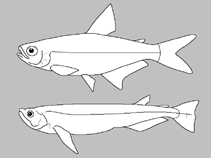
Classification / Noms
Noms communs | Synonymes | Catalog of Fishes(Genre, Espèce) | ITIS | CoL | WoRMS | Cloffa
>
Characiformes (Characins) >
Characidae (Characins; tetras) > Aphyocharacinae
Etymology: Aphyocharax: Greek, aphye, -es, sardine, anchovy + Greek, charax = a marine fish; diminutive (Ref. 45335); yekwanae: Named for the Ye'Kwana tribe that lives and oversees most of the Río Caura basin.
Eponymy: This species is named after the Ye’Kwana people (also ‘Ye-kuana’ – see above). They live in and oversee most of the Río Caura basin, Brazil. They are well known for their “…fervid desire to protect and manage their home territory and its environment.” (Ref. 128868), visit book page.
Environnement : milieu / zone climatique / profondeur / gamme de distribution
Écologie
; eau douce pélagique. Tropical
South America: Venezuela.
Taille / Poids / Âge
Maturité: Lm ? range ? - ? cm
Max length : 5.6 cm SL mâle / non sexé; (Ref. 49521)
Description synthétique
Clés d'identification | Morphologie | Morphométrie
Rayons mous dorsaux (Total) : 9; Rayons mous anaux: 15 - 17; Vertèbres: 36 - 37. Body with bright red coloration, from vertical through second to fifth branched anal-fin ray to vertical through apex of fork in caudal fin; adipose and posterior 2/3 of anal fin red. This coloration is believed to be autapomorphic. Distal margin of anal fin clear. Maxillary teeth 11-16; incompletely toothed maxilla (Ref. 49521).
Body shape (shape guide): fusiform / normal; Cross section: compressed.
Common in the lee side of islands and protected backwaters of the main river channel; sand with some rocks bottom. Also collected near mouths of streams where it could be muddy and covered with terrestrial plant leaves. Aquatic vegetation almost always absent; water clear to moderately turbid (Ref. 49521).
Cycle de vie et comportement reproducteur
Maturité | Reproduction | Frai | Œufs | Fécondité | Larves
Willink, P.W., B. Chernoff, A. Machado-Allison, F. Provenzano and P. Petry, 2003. Aphyocharax yekwanae, a new species of bloodfin tetra (Teleostei: Characiformes: Characidae) from the Guyana Shield of Venezuela. Ichthyol. Explor. Freshwat. 14(1):1-8. (Ref. 49521)
Statut dans la liste rouge de l'IUCN (Ref. 130435: Version 2025-2 (Global))
Menace pour l'homme
Harmless
Utilisations par l'homme
Outils
Articles particuliers
Télécharger en XML
Sources Internet
Estimations basées sur des modèles
Indice de diversité phylogénétique (Réf.
82804): PD
50 = 0.5005 [Uniqueness, from 0.5 = low to 2.0 = high].
Bayesian length-weight: a=0.01122 (0.00514 - 0.02450), b=3.04 (2.87 - 3.21), in cm total length, based on all LWR estimates for this body shape (Ref.
93245).
Niveau trophique (Réf.
69278): 3.4 ±0.4 se; based on size and trophs of closest relatives
Vulnérabilité de la pêche (Ref.
59153): Low vulnerability (10 of 100).
🛈