>
Gobiiformes (Gobies) >
Gobiidae (Gobies) > Gobiinae
Etymology: Trimma: Greek, trimma, -atos = something crushed (Ref. 45335); annosum: Named in allusion to the plain grey cheek of the species, which is perhaps reminiscent of that class of elderly hirsute human males sometimes referred to as 'greybeards' (Ref. 49832).
More on author: Winterbottom.
Entorno: milieu / zona climática / rango de profundidad / gama de distribución
Ecología
marino asociado a arrecife; rango de profundidad 1 - 60 m (Ref. 100726). Tropical
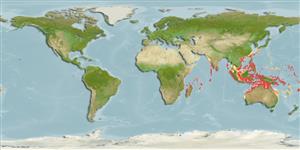
Indo-West Pacific: Maldives and India to Papua New Guinea.
Tamaño / Peso / Edad
Madurez: Lm ? range ? - ? cm
Max length : 2.8 cm SL macho / no sexado; (Ref. 100726)
Descripción breve
Claves de identificación | Morfología | Morfometría
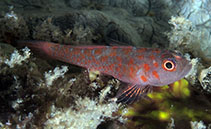
Espinas dorsales (total) : 7; Radios blandos dorsales (total) : 8; Espinas anales: 1; Radios blandos anales: 8. This species is distinguished by the following characters: a shallow concave bony interorbital about half pupil-diameter in width; predorsal is completely covered with ctenoid scales, no naked patches, a large scale above and between the end of the eyes above the posterior half of the pupil; cheek no scales; operculum often with a single large ctenoid scale dorsally, often followed by a smaller cycloid scale posteriorly; pectoral-fin base with 3 large vertically elongate cycloid scales; prepelvic area has 4-5 rows of cycloid scales, 1 enlarged scale between the bases of the pelvic spines; pectoral rays normally unbranched, rarely with up to 4 rays with a single branch; fifth pelvic-fin ray branched once dichotomously, rarely branched twice resulting in 3 terminal tips, 40-65% the length of the fourth; no trough or groove posterodorsal to the eye; second and third dorsal spines subequal in length, not elongated; colour of head bluish grey, cheek uniform in colour, in life a yellowish orange spot about the size of the pupil on the middle of the anterior part of the operculum, a similar sized spot dorsally and posteriorly on the operculum, a smaller yellowish orange spot behind eye; central on the pectoral base is an oval yellowish orange to reddish orange spot; body with moderate sized yellowish orange spots in 4 rows anteriorly converging to 3 on the caudal peduncle; body is fully scaled; without nape crest; dorsal and anal rays usually I,8 (Ref. 100726).
Cross section: oval.
Inhabits reef caves and crevices in 1-14 m (Ref. 90102).
Ciclo vital y comportamiento de apareamiento
Madurez | Reproducción | Puesta | Huevos | Fecundidad | Larva
Winterbottom, R., 2003. A new species of the gobiid fish Trimma from the western Pacific and northern Indian Ocean coral reefs, with a description of its osteology. Zootaxa 218:1-24. (Ref. 49832)
Situación en la Lista Roja de la UICN (Ref. 130435: Version 2025-2 (Global))
Amenaza para el ser humano
Harmless
Usos humanos
Pesquerías: sin interés
Herramientas
Informes especiales
Descargar XML
Fuentes de Internet
Estimaciones basadas en modelos
Temperatura preferida (Referencia
123201): 25.5 - 29, mean 28 °C (based on 862 cells).
Índice de diversidad filogenética (Referencia
82804): PD
50 = 0.5000 [Uniqueness, from 0.5 = low to 2.0 = high].
Bayesian length-weight: a=0.01023 (0.00477 - 0.02194), b=3.01 (2.83 - 3.19), in cm total length, based on LWR estimates for this (Sub)family-body shape (Ref.
93245).
Resiliencia (Referencia
120179): Alto, población duplicada en un tiempo mínimo inferior a 15 meses (Preliminary K or Fecundity.).
Vulnerabilidad pesquera (Ref.
59153): Low vulnerability (10 of 100).
🛈
Nutrientes (Ref.
124155): Calcium = 314 [140, 851] mg/100g; Iron = 1.5 [0.7, 3.1] mg/100g; Protein = 18.1 [16.0, 19.9] %; Omega3 = 0.184 [0.068, 0.450] g/100g; Selenium = 31.5 [11.8, 76.7] μg/100g; VitaminA = 130 [32, 526] μg/100g; Zinc = 3.66 [2.14, 5.83] mg/100g (wet weight);