>
Gobiiformes (Gobies) >
Schindleriidae (Infantfishes)
Etymology: Schindleria: Named for ichthyologist Otto Schindler, 1906-1959 (Prof. Dr. Konrad Schindler, pers. comm Dec. 2017); brevipinguis: From the small size of the species ('brevi') and the deeper, broader ('pinguis' = stout) body.
Eponymy: Otto Schindler (1906–1959) was an ichthyologist at Zoologische Staatssammlung München, Germany, where he was the first post-war Curator of Ichthyology (1949). [...] (Ref. 128868), visit book page.
Ambiente: milieu / zona climatica / distribuzione batimetrica / gamma di distribuzione
Ecologia
marino associati a barriera corallina; distribuzione batimetrica 15 - 30 m (Ref. 52019). Subtropical
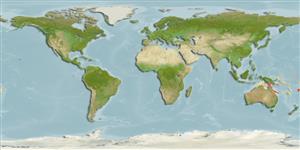
Western Pacific: Australia.
Lunghezza alla prima maturità / Dimensione / Peso / Età
Maturità: Lm 0.7, range 1 - 0.8 cm
Max length : 0.8 cm SL (female)
Breve descrizione
Chiavi di identificazione | Morfologia | Morfometria
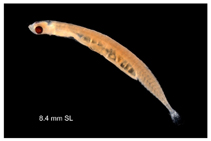
Raggi dorsali molli (totale) : 13; Raggi anali molli: 10 - 11; Vertebre: 35 - 36. Body small, stout, unpigmented. Body depth at pectoral-fin origin 9-12% of standard length and at anal-fin origin 9-14% SL. First dorsal-fin ray at myomere 18-20 and first anal-fin ray below dorsal-fin ray 4. Vertebrae 20 + 15-16 = 35-36, myomeres 19-20 + 14-16 = 34-36. Premaxillae and dentaries lack teeth. Males have a rod-like, flexible urogenital papilla lacking lobes, projections, or accessory papillae, with distal half tapering to a blunt point and usually anteriorly directed.
Recently reported as the smallest vertebrate. Males average 7.7 millimeters long and the gravid female which is 8.4 millimeters weighed 1 milligram. This pedomorphic species has a life span of only 2 months, has dispensed its fishy appendages such as teeth and scales, and has no pigment except in the eyes (Ref. 52508). Specimens were collected in oblique plankton net tows (Ref. 52019).
Ciclo vitale e comportamento di accoppiamento
Maturità | Riproduzione | Deposizione | Uova | Fecondità | Larve
Adults with mature gonads while retaining postlarval characters (Ref. 205). Distinct pairing (Ref. 205).
Watson, W. and H.J. Walker Jr., 2004. The world's smallest vertebrate, Schindleria brevipinguis, a new paedomorphic species in the family Schindleriidae (Perciformes: Gobioidei). Rec. Aust. Mus. 56:139-142. (Ref. 52019)
Stato della Lista Rossa IUCN (Ref. 130435: Version 2025-2 (Global))
Minaccia per l'uomo
Harmless
Usi umani
Pesca: di nessun interesse
Strumenti
Rapporti speciali
Scarica XML
Fonti Internet
Stime basate su modelli
Temperatura preferita (Fonte Biblio.
123201): 26.1 - 27.3, mean 26.3 °C (based on 14 cells).
Indice di diversità filogenetica (Fonte Biblio.
82804): PD
50 = 0.5005 [Uniqueness, from 0.5 = low to 2.0 = high].
Bayesian length-weight: a=0.00389 (0.00180 - 0.00842), b=3.12 (2.94 - 3.30), in cm total length, based on all LWR estimates for this body shape (Ref.
93245).
Livello trofico (Fonte Biblio.
69278): 2.9 ±0.4 se; based on size and trophs of closest relatives
Resilienza (Fonte Biblio.
120179): Basso, tempo minimo di raddoppiamento della popolazione 4.5 - 14 anni (Assuming Fec < 100).
Vulnerabilità della pesca (Ref.
59153): Low vulnerability (10 of 100).
🛈