Klassifizierung / Names
Namen | Synonyme | Catalog of Fishes(Gattung, Arten) | ITIS | CoL | WoRMS | Cloffa
>
Cyprinodontiformes (Rivulines, killifishes and live bearers) >
Poeciliidae (Poeciliids) > Poeciliinae
Etymology: Poecilia: Greek, poikilos = with a lot of colours (Ref. 45335); kykesis: Name from Greek 'Kykesis' for 'a mixing', refering to the confusing mixture of homonyms,
caused by the double recognition Poecilia petenensis and Mollienesia petenensis as congeneric species.
Umwelt: Milieu / Klimazone / Tiefenbereich / Verbreitungsgebiet
Ökologie
; süßwasser; brackwasser benthopelagisch. Tropical
North Central America: Guatemala (from the tributary of Rio Usumacinta and nearby lakes, Péten) to Mexico (Yucatan Peninsula).
Größe / Gewicht / Alter
Geschlechtsreife: Lm ? range ? - ? cm
Max length : 13.0 cm SL Männchen/unbestimmt; (Ref. 125334); 10.0 cm SL (female)
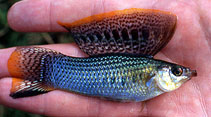
Rückenflossenweichstrahlen (insgesamt) : 12 - 16; Afterflossenweichstrahlen: 9. This species is distinguished by the following characters: D 12-16; A 9; lateral line scales 28-29; circumpendancular scales 20; no specific body pigmentation, except for the black margined scale; in adult males, the black margins can form spots, extending the rows of spots found on the caudal fin; caudal fin with a slightly produced lower margin (Ref. 84929).
Cross section: compressed.
This species is like other species in the Poecilia latipinna complex, which occurs in shallow, brackish to freshwater coastal areas such as tidal lagoons, lakes, creeks, and pools. It is also found across a range of turbidity (clear to muddy) and substrate types (mud, sand, clay) and is sometimes associated with submerged or emergent aquatic vegetation (Ref. 125334).
Lebenszyklus und Paarungsverhalten
Geschlechtsreife | Fortpflanzung | Ablaichen | Eier | Fruchtbarkeit | Larven
Poeser, F.N., 2003. Poecilia kykesis nom. nov., a new name for Mollienesia petenensis Günther, 1866, and redescription, revalidation and the designation of a lectotype for Poecilia petenensis Günther, 1866 (Teleostei: Poeciliidae). Contributions to Zoology 70(4):243-246. (Ref. 84929)
IUCN Rote Liste Status (Ref. 130435: Version 2025-2 (Global))
Bedrohung für Menschen
Harmless
Nutzung durch Menschen
Tools
Zusatzinformationen
Download XML
Internet Quellen
Schätzungen auf der Grundlage von Modellen
Phylogenetischer Diversitätsindex (Ref.
82804): PD
50 = 0.5000 [Uniqueness, from 0.5 = low to 2.0 = high].
Bayesian length-weight: a=0.01288 (0.00551 - 0.03009), b=3.14 (2.96 - 3.32), in cm total length, based on LWR estimates for this Genus-body shape (Ref.
93245).
Trophische Ebene (Ref.
69278): 2.3 ±0.2 se; based on size and trophs of closest relatives
Widerstandsfähigkeit (Ref.
120179): mittel, Verdopplung der Population dauert 1,4 - 4,4 Jahre. (Preliminary K or Fecundity.).
Anfälligkeit der Fischerei (Ref.
59153): Low vulnerability (10 of 100).
🛈