>
Siluriformes (Catfishes) >
Trichomycteridae (Pencil or parasitic catfishes) > Trichomycterinae
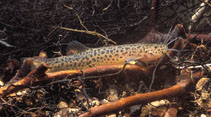
Etymology: Trichomycterus: Greek, thrix = hair + Greek, mykter, -eros = nose (Ref. 45335); maracaya: The specific name maracaya (also mbaracaya) is a Tupi-Guarani Amerindian name for the margay wild cat (Leopardus wiedii), an allusion both to the blotched pigmentation pattern of this species and its predatory habits on vertebrates (tadpoles).
Milieu: milieu / Klimaatzone / Diepte / verspreidingsgebied
Ecologie
; zoet water demersaal; diepte ? - 1 m (Ref. 51380). Tropical
South America: Rio Pardo drainage, upper Rio Paraná, southeastern Brazil.
Grootte / Gewicht / Leeftijd
Maturiteit: Lm ? range ? - ? cm
Max length : 5.1 cm SL mannelijk / geslacht onbekend; (Ref. 51380)
Korte beschrijving
Determinatiesleutels | Morfologie | Morfometrie
Wervels: 42. Belongs to the Trichomycterus brasiliensis species-complex based on the possession of the following apomorphic characters unique in Trichomycterus: four longitudinal rows of well-defined blotches formed by very dense concentration of dark chromatophores in the deeper layer of skin; and pectoral fin with I+5-6 rays. Members of this putative clade, except T. iheringi, may be further distinguished from other species of Trichomycterus
in having the bases of the pelvic fins very close to each other, sometimes in contact. Differs from the remaining species of Trichomycterus (except T. brasiliensis and T. potschi) in retaining the primordial epiphyseal cartilaginous bar separating the anterior and posterior cranial fontanels even in larger individuals. Distinguished further from other species of the T. brasiliensis species-complex and from all congeners in the following putative autapomorphies: row of blotches on lateral surface not forming a lateral stripe in any stage during ontogeny; and superficial layer of pigmentation of juveniles and larger, presumably adult, specimens formed by scattered chromatophores (Ref. 51380).
A rheophilic species which dwells on limonite rocky bottom streamlet with pebbles and sand, and pools with muddy bottom and accumulated plant debris. Crepuscular and nocturnal, it forages on the bottom and picks mostly benthic prey. Feeds on immature aquatic insects (ephemeropterans, trichopterans, and plecopterans) with larger individuals preying on small tadpoles (Ref. 51380).
Levenscyclus en paargedrag
Maturiteit | Voortplanting | Paaien | Eieren | Fecunditeit | Larven
Bockmann, F.A. and I. Sazima, 2004. Trichomycterus maracaya, a new catfish from the upper rio Paraná, southeastern Brazil (Siluriformes: Trichomycteridae), with notes on the T. brasiliensis species-complex. Neotrop. Ichthyol. 2(2):651-74. (Ref. 51380)
Status op de Rode Lijst van het IUCN (Ref. 130435: Version 2025-2 (Global))
Gevaar voor de mens
Harmless
Gebruik door de mens
Tools
Speciale rapporten
Download XML
Internetbronnen
Schattingen op basis van modellen
Fylogenetische diversiteitsindex (Ref.
82804): PD
50 = 0.5000 [Uniqueness, from 0.5 = low to 2.0 = high].
Bayesian length-weight: a=0.00912 (0.00396 - 0.02102), b=2.97 (2.79 - 3.15), in cm total length, based on LWR estimates for this Genus-body shape (Ref.
93245).
Trofisch niveau (Ref.
69278): 3.3 ±0.39 se; based on food items.
Weerstandsvermogen (Ref.
120179): laag, minimale populatieverdubbelingstijd 4,5-14 jaar (Assuming Fec < 100).
Kwetsbaarheid van de visserij (Ref.
59153): Low vulnerability (10 of 100).
🛈