Classificação / Nomes
Nomes comuns | Sinónimos | Catalog of Fishes(Género, Espécies) | ITIS | CoL | WoRMS | Cloffa
>
Cichliformes (Cichlids, convict blennies) >
Cichlidae (Cichlids) > Pseudocrenilabrinae
Etymology: Lamprologus: Greek, lampros = light + Greek, lagos = hare (Ref. 45335); tigripictilis: From the characteristic pattern of dark bands on the flanks of this species (Ref. 52248).
Ambiente: milieu / zona climática / intervalo de profundidade / gama de distribuição
Ecologia
; Água doce bentopelágico. Tropical
Africa: Lower Congo River basin, from just downstream of the mouth of the Inkisi River to the Inga Rapids (Ref. 97099). Report from below Inga (Matadi and Boma; Ref. 52248) refer to Lamprologus markerti (Ref. 97099).
Tamanho / Peso / Idade
Maturidade: Lm ? range ? - ? cm
Max length : 8.4 cm SL macho/indeterminado; (Ref. 97099)
Descrição breve
Chaves de identificação | Morfologia | Morfometria
Espinhos dorsais (total) : 17 - 19; Raios dorsais moles (total) : 7 - 10; Espinhos anais: 5 - 7; Raios anais moles: 5 - 8; Vértebras: 31 - 33. An elongate, relatively shallow-bodied species (Ref. 52248). Head length 29.4-33.1% of standard length (Ref. 52248). Jaws isognathous, but with lower lip sometimes protruding slightly, with both outer and inner row teeth pointed unicuspids in both jaws (Ref. 52248). Lower pharyngeal jaw is wider than long, with strongly interdigitating ventral suture; usually 24-28 teeth in posterior tooth row (Ref. 52248). Gill rakers are slender, elongate and non-denticulate (Ref. 52248). Spines in dorsal and anal fin are gradually increasing in length posteriorly; both fins with tapering filamentous extensions reaching to the middle of the caudal fin (Ref. 52248). Caudal fin large, rounded, and paddle-shaped, with 14 branched rays; often appearing lance-shaped, subacuminate in preserved specimens or when adducted (Ref. 52248). Pectoral fins are short, not reaching vertical through anus (Ref. 52248). Pelvic fins are in both sexes somewhat produced, reaching to between anus and anal fin origin, with second ray longest in fin (Ref. 52248). Flank scales are large, ctenoid, and regularly imbricating; cheek and chest naked, belly with small scales; large, embedded scales on opercle and subopercle; caudal fin with small scales over more than one-half of its length (Ref. 52248).
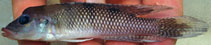
Colouration: Base body coloration is dark gray-brown; dorsum quite dark, brownish anterior to dorsal fin origin, more gray posteriorly; with 9 to 10 relatively dark vertical bars of varying thickness along flanks (Ref. 52248). A scaleless, dark opercular spot is present (Ref. 52248). Dorsal and anal fins are blackish, caudal fin membranes covered with rows on black maculae, often blending together to form about 6 blackish vertical bands (Ref. 52248). Transition from gray-brown through yellowish to white on belly; hints of yellow on cheek, bluish highlights around ventral edge of orbit posterior to lachrymal (Ref. 52248). Individual flank scales with dark pigment distributed uniformly along exposed posterior margin, creating intersecting rows of thin, oblique bands of pigment presenting appearance of chain-link fence or chain-mail (Ref. 52248). Preserved coloration dark brown, with blackish dorsal, anal, caudal and pelvic fins; banding and spotting visible on caudal fins (Ref. 52248).
Body shape (shape guide): fusiform / normal.
Gut contents included sand, detritus, and insect parts, including apparently aquatic insect larvae and an adult dipteran (Ref. 55248).
Ciclo de vida e comportamento de acasalamento
Maturidade | Reprodução | Desova | Ovos | Fecundidade | Larvas
Schelly, R.C. and M.L.J. Stiassny, 2004. Revision of the Congo River Lamprologus Schilthuis, 1891 (Teleostei: Cichlidae), with descriptions of two new species. Am. Mus. Novit. 3451:40 p. (Ref. 52248)
Categoria na Lista Vermelha da IUCN (Ref. 130435: Version 2025-2 (Global))
Ameaça para o homem
Harmless
Utilização humana
Ferramentas
Relatórios especiais
Descarregue XML
Fontes da internet
Estimativas baseadas em modelos
Índice de diversidade filogenética (Ref.
82804): PD
50 = 0.5000 [Uniqueness, from 0.5 = low to 2.0 = high].
Bayesian length-weight: a=0.01445 (0.00671 - 0.03113), b=2.99 (2.82 - 3.16), in cm total length, based on LWR estimates for this (Sub)family-body shape (Ref.
93245).
Nível Trófico (Ref.
69278): 3.8 ±0.5 se; based on size and trophs of closest relatives
Resiliência (Ref.
120179): Elevada, tempo mínimo de duplicação da população menor que 15 meses (Preliminary K or Fecundity.).
Vulnerabilidade da pesca (Ref.
59153): Low vulnerability (10 of 100).
🛈