>
Eupercaria/misc (Various families in series Eupercaria) >
Labridae (Wrasses) > Cirrhilabrinae
Etymology: Cirrhilabrus: Latin, cirrus = curl fringe + Greek, labros = furious (Ref. 45335); marjorie: Named for Marjorie Awai, Curator of the Florida Aquarium, and former Curatorial Assistant in the ichthyology Department at the Bishop Museum. The specific name is treated as Noun in apposition.
Eponymy: Marjorie Awai was Curator of the Florida Aquarium, and former Curatorial Assistant in the Ichthyology Department at the Bishop Museum. [...] (Ref. 128868), visit book page.
More on authors: Allen, Randall & Carlson.
Umwelt: Milieu / Klimazone / Tiefenbereich / Verbreitungsgebiet
Ökologie
seewasser riff-verbunden; tiefenbereich 20 - 50 m (Ref. 52303), usually 30 - 36 m (Ref. 52303). Tropical
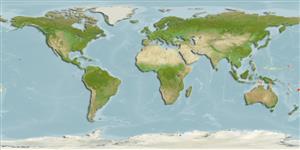
Western Central Pacific: Fiji.
Größe / Gewicht / Alter
Geschlechtsreife: Lm ? range ? - ? cm
Max length : 5.8 cm SL Männchen/unbestimmt; (Ref. 52303)
Rückenflossenstacheln (insgesamt) : 11; Rückenflossenweichstrahlen (insgesamt) : 9; Afterflossenstacheln: 3; Afterflossenweichstrahlen: 9. Diagnosis: Dorsal rays XI, 9; anal rays III, 9; pectoral rays 15; lateral line scales 16 + 7; median predorsal scales 5; horizontal scale rows on cheek below eye 2; gill rakers 18 - 19; body depth 3.1 - 3.2 in SL; head length 3.1 - 3.2 in SL; snout length 3.5 - 4.0 in head; caudal fin of females truncate to slightly emarginate, that of males lunate; pelvic fins of both sexes relatively short, not reaching anal fin origin when depressed; diagnostic live color pattern features of males include brilliant red upper half of head and body, greyish white lower, with four or five purplish stripes on lower half of body, yellow caudal fin, and bold black margins on dorsal and caudal fins; females mainly reddish pink with large and caudal fins; females mainly reddish pink with large black spot at base of uppermost caudal fin rays (Ref. 52303).
Body shape (shape guide): fusiform / normal; Cross section: compressed.
Lebenszyklus und Paarungsverhalten
Geschlechtsreife | Fortpflanzung | Ablaichen | Eier | Fruchtbarkeit | Larven
Distinct pairing during breeding (Ref. 205).
Allen, G.R., J.E. Randall and B.A. Carlson, 2003. Cirrhilabrus marjorie, a new wrasse (Pisces: Labridae) from Fiji. aqua, J. Ichthyol. Aquat. Biol. 7(3):113-118. (Ref. 52303)
IUCN Rote Liste Status (Ref. 130435: Version 2025-2 (Global))
Bedrohung für Menschen
Harmless
Nutzung durch Menschen
Tools
Zusatzinformationen
Download XML
Internet Quellen
Schätzungen auf der Grundlage von Modellen
Bevorzugte Temperatur (Ref.
123201): 26.3 - 28.7, mean 27.3 °C (based on 29 cells).
Phylogenetischer Diversitätsindex (Ref.
82804): PD
50 = 0.5000 [Uniqueness, from 0.5 = low to 2.0 = high].
Bayesian length-weight: a=0.01072 (0.00427 - 0.02691), b=3.03 (2.81 - 3.25), in cm total length, based on LWR estimates for this (Sub)family-body shape (Ref.
93245).
Trophische Ebene (Ref.
69278): 3.3 ±0.4 se; based on size and trophs of closest relatives
Widerstandsfähigkeit (Ref.
120179): hoch, Verdopplung der Population dauert weniger als 15 Monate. (Preliminary K or Fecundity.).
Anfälligkeit der Fischerei (Ref.
59153): Low vulnerability (10 of 100).
🛈