>
Blenniiformes (Blennies) >
Tripterygiidae (Triplefin blennies) > Tripterygiinae
Etymology: Helcogramma: Greek, helkos, -eos, -ous = ulcer, sore + Greek, gramma = letter, mark (Ref. 45335); albimacula: The species epithet is a combination of the Latin "albus", meaning white, and "macula", meaning spot. The name refers to the pale spot on the ventral part of the pectoral fin base of preserved specimens and is treated as Noun in apposition.
Environnement : milieu / zone climatique / profondeur / gamme de distribution
Écologie
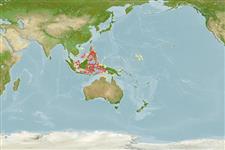
marin benthopélagique; profondeur 0 - 5 m (Ref. 52308). Tropical
Western Pacific.
Taille / Poids / Âge
Maturité: Lm ? range ? - ? cm
Max length : 4.2 cm TL mâle / non sexé; (Ref. 90102)
Description synthétique
Clés d'identification | Morphologie | Morphométrie
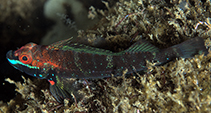
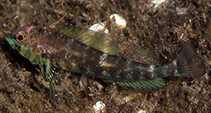
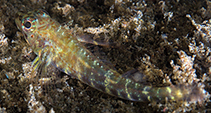
Épines dorsales (Total) : 16 - 18; Rayons mous dorsaux (Total) : 11 - 12; Épines anales: 1; Rayons mous anaux: 20 - 22; Vertèbres: 37. A species of Helcogramma (sensu Hansen, 1986) with 2 symphysial mandibular sensory pores, second dorsal fin spines usually XIV (two of 80 specimens with XIII and 11 with XV), third dorsal fin segmented rays 10-11, last ribs on vertebral centrum 10, vertebrae modally 10+27=37, pored lateral line scales modally 19 or 20, nape scales present, males with dusky anal fin, both sexes with distinctive pale (red in life), oblong streak over lowest pectoral fin ray bases, adult males first dorsal elongate, reaching base of fourth to sixth spine of second dorsal fin when depressed (Ref. 52308).
Body shape (shape guide): elongated.
Adults are found at depths of 5 m and shallower, in surge channels and exposed boulders (Ref. 90102). Eggs are hemispherical and covered with numerous sticky threads that anchor them in the algae on the nesting sites (Ref. 240). Larvae are planktonic which occur primarily in shallow, nearshore waters (Ref. 94114). Minimum depth from Ref. 58018.
Cycle de vie et comportement reproducteur
Maturité | Reproduction | Frai | Œufs | Fécondité | Larves
Williams, J.T. and J.C. Howe, 2003. Seven new species of the triplefin fish genus Helcogramma (Tripterygiidae) from the Indo-Pacific. aqua, J. Ichthyol. Aquat. Biol. 7(4):151-176. (Ref. 52308)
Statut dans la liste rouge de l'IUCN (Ref. 130435: Version 2025-2 (Global))
Menace pour l'homme
Harmless
Utilisations par l'homme
Outils
Articles particuliers
Télécharger en XML
Sources Internet
Estimations basées sur des modèles
Température préférée (Réf.
123201): 28 - 29.3, mean 28.8 °C (based on 659 cells).
Indice de diversité phylogénétique (Réf.
82804): PD
50 = 0.5000 [Uniqueness, from 0.5 = low to 2.0 = high].
Bayesian length-weight: a=0.00617 (0.00290 - 0.01310), b=3.04 (2.86 - 3.22), in cm total length, based on LWR estimates for this (Sub)family-body shape (Ref.
93245).
Niveau trophique (Réf.
69278): 3.0 ±0.3 se; based on size and trophs of closest relatives
Résilience (Réf.
120179): Haut, temps minimum de doublement de population inférieur à 15 mois (Preliminary K or Fecundity.).
Vulnérabilité de la pêche (Ref.
59153): Low vulnerability (10 of 100).
🛈
Nutriments (Ref.
124155): Calcium = 1040 [381, 4,376] mg/100g; Iron = 3.87 [1.37, 9.59] mg/100g; Protein = 16.7 [15.0, 18.5] %; Omega3 = 0.131 [0.028, 0.663] g/100g; Selenium = 82.7 [14.6, 419.3] μg/100g; VitaminA = 24.4 [3.2, 187.4] μg/100g; Zinc = 5.78 [2.59, 10.97] mg/100g (wet weight);