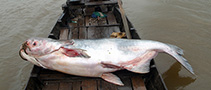
การจำแนกประเภท / ชื่อ
ชื่อสามัญ | ชื่อพ้อง | Catalog of Fishes(สกุล, ชนิด) | ITIS | CoL | WoRMS | Cloffa
>
Siluriformes (Catfishes) >
Pangasiidae (Shark catfishes)
Etymology: Pangasianodon: The Vietnamese name of a fish + Greek, odous = teeth (Ref. 45335).
Eponymy: Gigas was a giant in Greek mythology, the child of Uranus and Gaea. The name is applied to taxa that are giants of their kind. (Ref. 128868), visit book page.
สิ่งแวดล้อม : สิ่งแวดล้อม / เขตภูมิอากาศ / ระดับความลึก / ระยะการกระจายสินค้า
นิเวศวิทยา
; น้ำจืด กลุ่มสัตว์หน้าดิน,กลุ่มสัตว์พื้นท้องน้ำ; สัตว์น้ำจืดที่มีการอพยพอย่างแท้จริงภายในแหล่งน้ำจืดเท่านั้น (Ref. 131118). Tropical
Asia: endemic to the Mekong basin where it has become rare due to overexploitation.
ขนาด / น้ำหนัก / อายุ
วัยเจริญพันธุ์: Lm ? range ? - ? cm
Max length : 300 cm TL เพศผู้/กระเทย; (Ref. 30857); 235.0 cm SL (female); น้ำหนักสูงสุดที่มีการรายงาน: 350.0 kg (Ref. 43281); อายุสูงสุดที่ได้รายงาน: 10 ปี (Ref. 116372)
คำอธิบายสั้นๆ
เครื่องมือที่ใช้ในการแยกชนิดสัตว์,สิ่งมีชีวิตออกจากกัน | สัณฐานวิทยา | ความยาวต่างๆ
เงี่ยงครีบหลัง (รวม) : 2; ก้านครีบอ่อนที่หาง (รวม) : 7 - 8; ก้านครีบอ่อนที่ก้น: 35; สัตว์มีกระดูกสันหลัง: 48. Body without stripes; posterior nostril located near anterior nostril; 7 branched dorsal-fin rays; gill rakers rudimentary or absent; fins grey, never black (Ref. 12693). The center of the eye above the horizontal line through the mouth angle in juveniles; eye totally below the level of mouth angle in subadults and adults. The maxillary and mandibulary pairs of barbels well developed in juveniles; mandibulary barbels become rudimentary in subadults and adults (Ref. 9448). Gigantic size; oral teeth and gill rakers present in small juveniles, absent at about 30-50 cm SL; dorsal, pelvic and pectoral fins without filamentous extensions (Ref. 43281). Distinguished from other large catfish in the Mekong by its lack of teeth and the almost complete absence of barbels (Ref. 2686)
Body shape (shape guide): elongated; Cross section: circular.
Facultative air-breathing (Ref. 126274); A migratory species (Ref. 37772) which occurs in medium to large-sized rivers (Ref. 12975). Adults feed on detritus and algae on the bottom (Ref. 58784); feeds only on vegetation in the river but takes other food in captivity; little is known on its general pattern of life and migratory journeys for spawning (Ref. 2686). Shows one of the fastest growth rates of any fish in the world, reaching 150 to 200 kg in 6 years (Ref. 12693). Cited in the Guinness Book of Records as largest freshwater fish (Ref. 6472). Marketed fresh (Ref. 12693). Maximum length of 300 cm needs confirmation. Threatened due to over harvesting and habitat loss (Ref. 58490).
วงจรชีวิตและพฤติกรรมการผสมพันธุ์
วัยเจริญพันธุ์ | การสืบพันธุ์ | การวางไข่ | เซลสืบพันธ์ของเพศเมีย(ไข่) | ความดกของไข่ | ตัวอ่อน
Roberts, T.R. and C. Vidthayanon, 1991. Systematic revision of the Asian catfish family Pangasiidae, with biological observations and descriptions of three new species. Proc. Acad. Nat. Sci. Philad. 143:97-144. (Ref. 7432)
สถานะบัญชีแดงของ IUCN (Ref. 130435: Version 2025-2 (Global))
ภัยคุกคามต่อมนุษย์
Harmless
การใช้ของมนุษย์
การประมง: การค้า; การเพาะเลี้ยงสัตว์น้ำ: การทดลอง
เครื่องมือ
รายงานพิเศษ
ดาวน์โหลด XML
แหล่งที่มาจากอินเตอร์เน็ต
การประมาณค่าตามแบบจำลอง
ดัชนีความหลากหลายทางวิวัฒนาการ (อ้างอิง
82804): PD
50 = 0.7500 [Uniqueness, from 0.5 = low to 2.0 = high].
Bayesian length-weight: a=0.00776 (0.00387 - 0.01555), b=3.14 (2.96 - 3.32), in cm total length, based on LWR estimates for this species & (Sub)family-body (Ref.
93245).
ระดับชั้นอาหาร (อ้างอิง
69278): 2.3 ±0.17 se; based on food items.
Generation time: 12.9 ( na - na) years. Estimated as median ln(3)/K based on 1
growth studies.
ความสามารถในการกลับคืนสู่ปกติ (อ้างอิง
120179): ต่ำ, เวลาต่ำสุดที่จะทำให้ประชากรเพิ่มขึ้นเป็น 2 เท่าใช้เวลา 4.5 - 14 ปี (Assuming tm=5-10; K=0.085).
ความเสี่ยงต่อการตกปลา (Ref.
59153): Very high vulnerability (79 of 100).
🛈