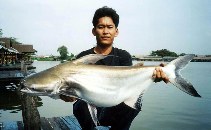
>
Siluriformes (Catfishes) >
Pangasiidae (Shark catfishes)
Etymology: Pangasius: The Vietnamese name of a fish (Ref. 45335).
Eponymy: Dr Yai Suapan Sanitwongse qualified as a physician at Edinburgh University (1885). [...] (Ref. 128868), visit book page.
More on author: Smith.
Environnement : milieu / zone climatique / profondeur / gamme de distribution
Écologie
; eau douce benthopélagique; potamodrome (Ref. 138296). Tropical; 25°N - 9°N
Asia: Chao Phraya and Mekong basins.
Taille / Poids / Âge
Maturité: Lm ? range ? - ? cm
Max length : 300 cm SL mâle / non sexé; (Ref. 2686); common length : 50.0 cm SL mâle / non sexé; (Ref. 2073); poids max. publié: 300.0 kg (Ref. 7432)
Fins are pigmented with dusky melanophores. First soft ray in dorsal, pectoral and pelvic fins prolonged into a filament (Ref. 4792). Broad head; black tips on first few anal-fin rays in individuals of all sizes, particularly in juveniles; palatine and vomerine teeth united into a single long crescentic patch (Ref. 12693). Mouth wide, its width 5.5-5.9 times in SL (Ref. 43281).
Body shape (shape guide): elongated; Cross section: compressed.
Facultative air-breathing (Ref. 126274); Adults inhabit large rivers. Juveniles are found in larger tributaries (Ref. 58784). Both young and adults feed on fishes and crustaceans (Ref. 12693). Larger individuals have been known to feed on carcasses of fowl or dog (which are commonly used for bait) (Ref. 7432). A migratory species (Ref. 37772). They spawn just before the rainy season and the young of the year reach a length of about 10 cm by mid-June (Ref. 12693). Fishery used to be accompanied by rites and ceremonies of a religious nature (Ref 2686). Important food fish and is often referred to in textbooks and popular press or news media (Ref. 4537). Marketed fresh (Ref. 12693). Threatened due to over harvesting, habitat loss and pollution (Ref. 58490).
Cycle de vie et comportement reproducteur
Maturité | Reproduction | Frai | Œufs | Fécondité | Larves
Roberts, T.R. and C. Vidthayanon, 1991. Systematic revision of the Asian catfish family Pangasiidae, with biological observations and descriptions of three new species. Proc. Acad. Nat. Sci. Philad. 143:97-144. (Ref. 7432)
Statut dans la liste rouge de l'IUCN (Ref. 130435: Version 2025-2 (Global))
Utilisations par l'homme
Pêcheries: commercial; Aquaculture: commercial; Aquarium: Commercial
Outils
Articles particuliers
Télécharger en XML
Sources Internet
Estimations basées sur des modèles
Indice de diversité phylogénétique (Réf.
82804): PD
50 = 0.5000 [Uniqueness, from 0.5 = low to 2.0 = high].
Bayesian length-weight: a=0.00457 (0.00217 - 0.00962), b=3.09 (2.91 - 3.27), in cm total length, based on LWR estimates for this (Sub)family-body shape (Ref.
93245).
Niveau trophique (Réf.
69278): 4.0 ±0.66 se; based on food items.
Vulnérabilité de la pêche (Ref.
59153): Very high vulnerability (90 of 100).
🛈