Klassifizierung / Names
Namen | Synonyme | Catalog of Fishes(Gattung, Arten) | ITIS | CoL | WoRMS | Cloffa
>
Siluriformes (Catfishes) >
Clariidae (Airbreathing catfishes)
Etymology: Clarias: Greek, chlaros = lively, in reference to the ability of the fish to live for a long time out of water.
Umwelt: Milieu / Klimazone / Tiefenbereich / Verbreitungsgebiet
Ökologie
; süßwasser demersal. Tropical
Asia: Borneo (Ref. 51593).
Größe / Gewicht / Alter
Geschlechtsreife: Lm ? range ? - ? cm
Max length : 31.6 cm SL Männchen/unbestimmt; (Ref. 51593)
Kurzbeschreibung
Bestimmungsschlüssel | Morphologie | Morphometrie
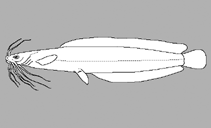
Rückenflossenstacheln (insgesamt) : 0; Rückenflossenweichstrahlen (insgesamt) : 87 - 90; Afterflossenstacheln: 0; Afterflossenweichstrahlen: 73 - 81. An anguilliform body (Ref. 51593). Head small, 18.5-21.1% of standard length, and narrow, 12.7-14.3% of standard length (Ref. 51593). Eyes small and laterally placed (Ref. 51593). Occipital process more or less angular and very short, its length varying between 4.6 and 6.8% of head length (Ref. 51593). Frontal fontanelle about twice as long as wide (Ref. 51593). Maxillary barbels reaching level of dorsal fin origin; nasal barbels almost reaching level of pectoral spine base, outer mandibular barbels about as long as head; inner mandibular barbels about half the head length (Ref. 51593). Dorsal, caudal and anal fins not confluent (Ref. 51593). Pelvic fin as well as pectoral fin and spine relatively short compared to other Asian Clarias species, nevertheless, pelvic fins are longer than those of Clarias nieuhofii (Ref. 51593). Pelvic fin reaching anal fin base (Ref. 51593). Pectoral fin not reaching level of dorsal fin origin; pectoral spine serrated on its outer side, while inner side with a few, upwardly pointed serrations (Ref. 51593). Lateral line appearing as a discrete white line running from posterolateral end of head to middle of caudal fin base (Ref. 51593). The skin is dark brown to black colored; the color is deeper on the dorsal surface of the body and the paired fins; the ventral surface is light brown (Ref. 51593). Above lateral line with 12-15 transverse rows of small white spots; below line with relatively numerous small spots in irregular, longitudinal band (Ref. 51593).
Body shape (shape guide): elongated.
Facultative air-breathing (Ref. 126274)
Lebenszyklus und Paarungsverhalten
Geschlechtsreife | Fortpflanzung | Ablaichen | Eier | Fruchtbarkeit | Larven
Sudarto, G.G. Teugels and L. Pouyaud, 2004. Description of a new clariid catfish, Clarias pseudonieuhofii from West Borneo (Siluriformes: Clariidae). Zool. Stud. 43(1):8-19. (Ref. 51593)
IUCN Rote Liste Status (Ref. 130435: Version 2025-2 (Global))
Bedrohung für Menschen
Harmless
Nutzung durch Menschen
Tools
Zusatzinformationen
Download XML
Internet Quellen
Schätzungen auf der Grundlage von Modellen
Phylogenetischer Diversitätsindex (Ref.
82804): PD
50 = 0.5000 [Uniqueness, from 0.5 = low to 2.0 = high].
Bayesian length-weight: a=0.00776 (0.00372 - 0.01620), b=2.96 (2.79 - 3.13), in cm total length, based on LWR estimates for this Genus-body shape (Ref.
93245).
Trophische Ebene (Ref.
69278): 3.5 ±0.5 se; based on size and trophs of closest relatives
Widerstandsfähigkeit (Ref.
120179): mittel, Verdopplung der Population dauert 1,4 - 4,4 Jahre. (Preliminary K or Fecundity.).
Anfälligkeit der Fischerei (Ref.
59153): Low to moderate vulnerability (29 of 100).
🛈