Klassifizierung / Names
Namen | Synonyme | Catalog of Fishes(Gattung, Arten) | ITIS | CoL | WoRMS | Cloffa
>
Siluriformes (Catfishes) >
Trichomycteridae (Pencil or parasitic catfishes) > Trichomycterinae
Etymology: Trichomycterus: Greek, thrix = hair + Greek, mykter, -eros = nose (Ref. 45335); trefauti: Named after Dr. Miguel Trefaut Rodrigues, who discovered and collected the first specimens of the species.
Eponymy: Dr Miguel Trefaut Urbano Rodrigues (d: 1953). (See Rodrigues) (Ref. 128868), visit book page.
Umwelt: Milieu / Klimazone / Tiefenbereich / Verbreitungsgebiet
Ökologie
; süßwasser benthopelagisch. Tropical
South America: known only from the type-locality : Riacho Andrequicé, Trinta Réis, Minas Gerais, Brazil.
Größe / Gewicht / Alter
Geschlechtsreife: Lm ? range ? - ? cm
Kurzbeschreibung
Bestimmungsschlüssel | Morphologie | Morphometrie
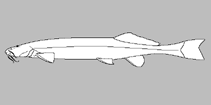
Rückenflossenstacheln (insgesamt) : 2; Rückenflossenweichstrahlen (insgesamt) : 7; Afterflossenstacheln: 1; Afterflossenweichstrahlen: 6. Trichomycterus trefauti differs from all other known members of the sub-family Trichomycterinae by the autapomorphic presence of ann elliptical, vertically elongated, brown spot, at caudal-fin base (vs. without elliptical spot at caudal-fin base), and the combination of homogeneously gray color pattern (vs. yellowfish, presence of stripes or or bands, or lack of color pattern), first pectoral-fin ray prolonged as a filament (vs. not prolonged), subterminal mouth (vs. inferior or terminal mouth), two supraorbital pores at interorbital space (vs. one supraorbital pore at mesial line), caudal fin truncate with attenuated edges (vs. caudal fin rounded), pelvic fins covering anus and urogenital openings (vs.not covering), interorbital space very wide 39.8-45.9% HL(vs. more or less than 39.8-45.9% HL), maxillary barbels very long 84.2-93.0% HL (vs.more or less than 84.2-93.0% HL), rictal barbels very long 67.6-74.3% HL (vs.more or less than 67.6-74.3%HL).
Body shape (shape guide): elongated.
Lebenszyklus und Paarungsverhalten
Geschlechtsreife | Fortpflanzung | Ablaichen | Eier | Fruchtbarkeit | Larven
Wosiacki, W.B., 2004. New species of the catfish genus Trichomycterus (Siluriformes, Trichomycteridae) from the headwaters of the rio São Francisco bason, Brazil. Zootaxa 592:1-12. (Ref. 52782)
IUCN Rote Liste Status (Ref. 130435: Version 2025-2 (Global))
Bedrohung für Menschen
Harmless
Nutzung durch Menschen
Tools
Zusatzinformationen
Download XML
Internet Quellen
Schätzungen auf der Grundlage von Modellen
Phylogenetischer Diversitätsindex (Ref.
82804): PD
50 = 0.5000 [Uniqueness, from 0.5 = low to 2.0 = high].
Bayesian length-weight: a=0.00912 (0.00396 - 0.02102), b=2.97 (2.79 - 3.15), in cm total length, based on LWR estimates for this Genus-body shape (Ref.
93245).
Trophische Ebene (Ref.
69278): 3.2 ±0.4 se; based on size and trophs of closest relatives
Widerstandsfähigkeit (Ref.
120179): niedrig, Verdopplung der Population dauert 4,5 - 14 Jahre. (Assuming Fec < 100).
Anfälligkeit der Fischerei (Ref.
59153): Low vulnerability (10 of 100).
🛈