Classification / Noms
Noms communs | Synonymes | Catalog of Fishes(Genre, Espèce) | ITIS | CoL | WoRMS | Cloffa
>
Blenniiformes (Blennies) >
Blenniidae (Combtooth blennies) > Salariinae
Etymology: poiti: Named after the Oceanographic Post of Trindade Island of the Brazilian Navy.
Eponymy: Named after the Posto Oceanográfico da Ilha da Trindade (Oceanographic Post of Trindade Island) of the Brazilian Navy, “in recognition of their extensive help during all trips by the authors.” (Ref. 128868), visit book page.
Environnement : milieu / zone climatique / profondeur / gamme de distribution
Écologie
marin récifal; profondeur 0 - 1 m (Ref. 49353). Tropical
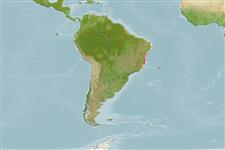
Southwest Atlantic: Trindade Island, Brazil.
Taille / Poids / Âge
Maturité: Lm ? range ? - ? cm
Max length : 8.5 cm SL mâle / non sexé; (Ref. 49353); 8.0 cm SL (female)
Description synthétique
Clés d'identification | Morphologie | Morphométrie
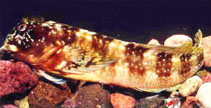
Épines dorsales (Total) : 11 - 12; Rayons mous dorsaux (Total) : 13 - 15; Épines anales: 2; Rayons mous anaux: 15 - 16. Diagnosis: This species is distinguished from its Atlantic congeners by its speckled body and head with small black spots (vs. absent in S. cristata); modally 14 segmented dorsal fin rays (vs. 15 of S. cristata from other Brazilian localities, S. caboverdiana, and
S. nuchifilis; and 16 in S. springeri); modally 16 segmented anal fin rays (vs. 17 of S. cristata from other Brazilian localities, S. caboverdiana, and S. nuchifilis; and 18 in S. springeri); modally 19 nuchal cirri (vs. 22 in S. cristata from other Brazilian localities, 5 in S. springeri, 6 in S. nuchifilis, and 17 in S. caboverdiana); and, modally 23 caudal vertebrae (vs. 24 in specimens of S. cristata
from other Brazilian localities, S. caboverdiana, and S. nuchifilis, and 25 in S. Springeri ). The means of counts of dorsal and anal rays are additional diagnostic characters.
Body shape (shape guide): fusiform / normal.
Recorded from 0.1 to 1.0 meter depth inside tide pools and in the surf zone over crustose algae or volcanic reefs. Observed to be extremely tolerant to high salinity and temperature variations. Adults occur with other blennies (Ophioblennius cf. atlanticus and an undescribed species of the genus Entomacrodus, labrisomids (Labrisomus nuchipinnis and an undescribed species of Malacoctenus), the Trindade damselfish (Stegastes fuscus trindadensis), and a Brazilian wrasse (Thalassoma noronhanum) (Ref. 49353). Oviparous. Eggs are demersal and adhesive (Ref. 205), and are attached to the substrate via a filamentous, adhesive pad or pedestal (Ref. 94114). Larvae are planktonic, often found in shallow, coastal waters (Ref. 94114).
Cycle de vie et comportement reproducteur
Maturité | Reproduction | Frai | Œufs | Fécondité | Larves
Oviparous, distinct pairing (Ref. 205).
Rangel, C.A, J.L. Gasparini and R.Z.P. Guimarães, 2004. A new species of combtooth blenny Scartelly Jordan, 1886 (Teleosteii: Blenniidae) from Trindade Island, Brazil. aqua, J. Ichthyol. Aquat. Biol. 8(3):89-96. (Ref. 49353)
Statut dans la liste rouge de l'IUCN (Ref. 130435: Version 2025-2 (Global))
Menace pour l'homme
Harmless
Utilisations par l'homme
Outils
Articles particuliers
Télécharger en XML
Sources Internet
Estimations basées sur des modèles
Température préférée (Réf.
123201): 25.5 - 25.6, mean 25.6 °C (based on 2 cells).
Indice de diversité phylogénétique (Réf.
82804): PD
50 = 0.5078 [Uniqueness, from 0.5 = low to 2.0 = high].
Bayesian length-weight: a=0.01047 (0.00463 - 0.02370), b=2.98 (2.79 - 3.17), in cm total length, based on LWR estimates for this (Sub)family-body shape (Ref.
93245).
Niveau trophique (Réf.
69278): 2.7 ±0.2 se; based on size and trophs of closest relatives
Résilience (Réf.
120179): Haut, temps minimum de doublement de population inférieur à 15 mois (Preliminary K or Fecundity.).
Vulnérabilité de la pêche (Ref.
59153): Low vulnerability (10 of 100).
🛈