Klassifizierung / Names
Namen | Synonyme | Catalog of Fishes(Gattung, Arten) | ITIS | CoL | WoRMS | Cloffa
>
Cyprinodontiformes (Rivulines, killifishes and live bearers) >
Rivulidae (Rivulines) > Kryptolebiatinae
Etymology: sepia: The name sepia alludes to the family Sepiidae, the cuttlefish, whose chromatophores also can cause rapid changes in color.
Umwelt: Milieu / Klimazone / Tiefenbereich / Verbreitungsgebiet
Ökologie
; süßwasser benthopelagisch. Tropical
South America: Tapanahony River drainage in Surinam.
Größe / Gewicht / Alter
Geschlechtsreife: Lm ? range ? - ? cm
Max length : 6.5 cm TL Männchen/unbestimmt; (Ref. 53862)
Kurzbeschreibung
Bestimmungsschlüssel | Morphologie | Morphometrie
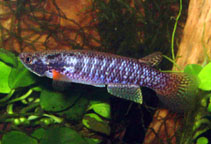
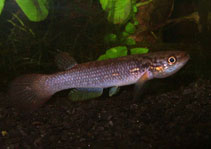
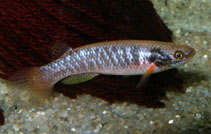
Differs from other Kryptolebias and Rivulus species by a combination of characters including low number of lateral line scales, high number of anal rays, short predorsal length and a robust body, and unique mitochondrial DNA gene sequences. Kryptolebias sepia differs further by remarkably strong melanistic pigmentation and the ability to change this coloration into several distinct patterns, lack of obvious sexual dimorphism, strong dichromatism between juveniles and adults, and absence of the Rivulus spot in females and juveniles (Ref. 53862).
Found only in primary forests with a very dense canopy cover and appears to inhabits only extremely shallow parts of small creeks in hilly areas. Occurs outside the main stream in swampy areas directly adjacent to creeks.
Lebenszyklus und Paarungsverhalten
Geschlechtsreife | Fortpflanzung | Ablaichen | Eier | Fruchtbarkeit | Larven
Vermeulen, F.B.M. and T. Hrbek, 2005. Kryptolebias sepia n. sp. (Actinopterygii: Cyprinidontiformes: Rivulidae), a new killifish from the Tapanahony River drainage in southeast Surinam. Zootaxa 928:1-20. (Ref. 53862)
IUCN Rote Liste Status (Ref. 130435: Version 2025-2 (Global))
Bedrohung für Menschen
Harmless
Nutzung durch Menschen
Tools
Zusatzinformationen
Download XML
Internet Quellen
Schätzungen auf der Grundlage von Modellen
Phylogenetischer Diversitätsindex (Ref.
82804): PD
50 = 0.5039 [Uniqueness, from 0.5 = low to 2.0 = high].
Bayesian length-weight: a=0.00389 (0.00180 - 0.00842), b=3.12 (2.94 - 3.30), in cm total length, based on all LWR estimates for this body shape (Ref.
93245).
Trophische Ebene (Ref.
69278): 3.2 ±0.4 se; based on size and trophs of closest relatives
Widerstandsfähigkeit (Ref.
120179): hoch, Verdopplung der Population dauert weniger als 15 Monate. (Preliminary K or Fecundity.).
Anfälligkeit der Fischerei (Ref.
59153): Low vulnerability (10 of 100).
🛈