Environnement : milieu / zone climatique / profondeur / gamme de distribution
Écologie
; eau douce démersal; profondeur 0 - 70 m (Ref. 55786). Tropical; 21°N - 20°N
Central America: Yucatan Peninsula, Mexico.
Taille / Poids / Âge
Maturité: Lm ? range ? - ? cm
Max length : 9.7 cm SL mâle / non sexé; (Ref. 55786); 8.9 cm SL (female)
Description synthétique
Clés d'identification | Morphologie | Morphométrie
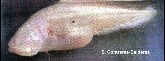
Rayons mous dorsaux (Total) : 75 - 87; Rayons mous anaux: 59 - 68; Vertèbres: 40 - 43. This species is distinguished by the following characters: anterior nostril placed low on snout; tip of opercular spine free; 2 pairs of psedoclaspers, inner one positioned in front of outer one; eyes not visible (eyes minute black dots in specimens less than 20 mm SL); head naked; otolith with fused colliculi; 3 lower preopercular pores; maxillary strongly vertically expanded posteriorly, knob at rear corner; 5-7 prolonged rakers on anterior gill arch; anterior anal fin pterygiophore elongated; pseudobranchial filaments absent (Ref. 55786).
Uncommon species found in caves and sinkholes (Ref. 34024). Associated with the blind synbranchid fish Ophisternon infernale (Hubbs, 1938) and several blind crustacean species. In only one cave, it was found with the catfish Rhamdia guatemalensis (Günther, 1864). This species does not react to flashlights, but darted away at the slightest vibration; it seems to feed on troglobitic shrimps and mysids. Newly-born juveniles are light yellow and about 20 mm long (Ref. 55786). Migratory behaviour is undetermined (Ref. 126106).
Cycle de vie et comportement reproducteur
Maturité | Reproduction | Frai | Œufs | Fécondité | Larves
Viviparous.
Møller, P.R., W. Schwarzhans and J.G. Nielsen, 2004. Review of the American Dinematichthyini (Teleostei, Bythitidae). Part I. Dinematichthys, Gunterichthys, Typhliasina and two new genera. aqua, J. Ichthyol. Aquat. Biol. 8(4):141-192. (Ref. 55786)
Statut dans la liste rouge de l'IUCN (Ref. 130435: Version 2025-2 (Global))
Menace pour l'homme
Harmless
Utilisations par l'homme
Pêcheries: sans intérêt
Outils
Articles particuliers
Télécharger en XML
Sources Internet
Estimations basées sur des modèles
Indice de diversité phylogénétique (Réf.
82804): PD
50 = 1.0000 [Uniqueness, from 0.5 = low to 2.0 = high].
Bayesian length-weight: a=0.00389 (0.00180 - 0.00842), b=3.12 (2.94 - 3.30), in cm total length, based on all LWR estimates for this body shape (Ref.
93245).
Niveau trophique (Réf.
69278): 3.4 ±0.5 se; based on size and trophs of closest relatives
Résilience (Réf.
120179): Faible, temps minimum de doublement de population : 4,5 à 14 années (Assuming Fec < 100).
Vulnérabilité de la pêche (Ref.
59153): Low vulnerability (10 of 100).
🛈