Classification / Noms
Noms communs | Synonymes | Catalog of Fishes(Genre, Espèce) | ITIS | CoL | WoRMS | Cloffa
>
Siluriformes (Catfishes) >
Loricariidae (Armored catfishes) > Hypostominae
Etymology: Ancistrus: Greek, agkistron = hook (Ref. 45335); tombador: Specific name tombador refers to Serra do Tombador, where the type locality is located.
Environnement : milieu / zone climatique / profondeur / gamme de distribution
Écologie
; eau douce démersal. Tropical
South America: Mato Grosso, Brazil.
Taille / Poids / Âge
Maturité: Lm ? range ? - ? cm
Max length : 6.3 cm SL mâle / non sexé; (Ref. 54498)
Description synthétique
Clés d'identification | Morphologie | Morphométrie
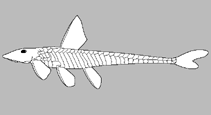
Rayons mous dorsaux (Total) : 8; Rayons mous anaux: 5; Vertèbres: 28. Can be easily distinguished from all congeners except Ancistrus reisi and A. jataiensis by lacking adipose fin. A series of 3 to 5 median, unpaired platelets forming a low crest is present in place of adipose fin. Platelets are followed by at least two dermal plates (more often three) of the dorso-lateral series that join dorsally, vs. platelets nearly immediately followed by the plate-like procurrent caudal rays in A. reisi and A. jataiensis. It further differs from all species of Ancistrus by the unique combination of the following characters: naked margin of snout large and tentacles usually absent in both sexes, body very narrow (cleithral width 27.5-31.2% SL, mean 29.4), and long caudal peduncle particularly depressed (depth 8.3-9.2% SL, mean 8.7) (Ref. 54498).
Body shape (shape guide): elongated.
Facultative or obligate air-breathing (Ref. 126274); Inhabits small rivers (Ref. 54498).
Cycle de vie et comportement reproducteur
Maturité | Reproduction | Frai | Œufs | Fécondité | Larves
Fisch-Muller, S., A.R. Cardoso, J.F.P. da Silva and V.A. Bertaco, 2005. Three new species of Ancistrus Kner (Teleostei: Siluriformes: Loricariidae) from the upper Tapajós and Tocantins rivers. Rev. Suisse de Zoologie 112(2):559-572. (Ref. 54498)
Statut dans la liste rouge de l'IUCN (Ref. 130435: Version 2025-2 (Global))
Menace pour l'homme
Harmless
Utilisations par l'homme
Pêcheries: sans intérêt
Outils
Articles particuliers
Télécharger en XML
Sources Internet
Estimations basées sur des modèles
Indice de diversité phylogénétique (Réf.
82804): PD
50 = 0.5000 [Uniqueness, from 0.5 = low to 2.0 = high].
Bayesian length-weight: a=0.01479 (0.00636 - 0.03440), b=2.98 (2.80 - 3.16), in cm total length, based on LWR estimates for this Genus-body shape (Ref.
93245).
Vulnérabilité de la pêche (Ref.
59153): Low vulnerability (10 of 100).
🛈