>
Ophidiiformes (Cusk eels) >
Bythitidae (Livebearing brotulas)
Etymology: Microbrotula: Greek, mikros = small + Latin, brotula, -ae = little, bud, shoot (Ref. 45335); bentleyi: Named for Andrew Charles Bentley of Port Elizabeth, South Africa, now at the University of Kansas, USA, for his enthusiasm and help in the development of a program on western Indian Ocean fishes, and for collecting the holotype.
Eponymy: Andrew Charles Bentley is an ichthyologist. [...] (Ref. 128868), visit book page.
Ambiente: milieu / zona climatica / distribuzione batimetrica / gamma di distribuzione
Ecologia
marino associati a barriera corallina; distribuzione batimetrica 0 - 55 m (Ref. 54832). Tropical
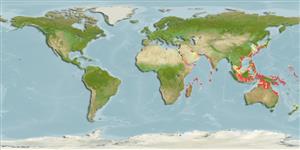
Indo-Pacific: South Africa to the Red Sea and from the Philippines to Cape York Peninsula in northern Australia; widely distributed and large gap in the distribution is probably a collecting artefact rather than indicative of a true distribution.
Dimensione / Peso / Età
Maturità: Lm ? range ? - ? cm
Max length : 4.0 cm SL maschio/sesso non determinato; (Ref. 54832); 4.1 cm SL (female)
Breve descrizione
Chiavi di identificazione | Morfologia | Morfometria
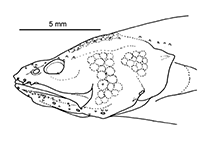
Raggi dorsali molli (totale) : 61 - 70; Raggi anali molli: 50 - 57; Vertebre: 44 - 47. This species is distinguished by the following characters: vertebrae 11-12+33-35=44-47; fin rays, on dorsal 61-70, anal 50-57, pectoral 15-17, caudal 7-8; anterior dorsal fin ray above vertebra number 7-8, anterior anal fin ray below dorsal fin ray number 12-16, anterior anal fin ray below vertebra 13-16; small forward-curved spine at lower angle of preopercle, hidden by skin; fleshy interorbital width 4.5-7.0% SL; palatine teeth papillae-like or absent (Ref. 88975).
Body shape (shape guide): elongated; Cross section: compressed.
Found from near the surface to 55 meters in protected reef structures (Ref. 54832). Solitary inhabitant of reef crevices, cryptic (Ref 90102).
Ciclo vitale e comportamento di accoppiamento
Maturità | Riproduzione | Deposizione | Uova | Fecondità | Larve
Schwarzhans, W. and J.G. Nielsen, 2011. Revision of the genus Microbrotula (Teleostei: Bythitidae), with description of two new species and a related new genus. The Beagle, Records of the Museums and Art Galleries of the Northern Territory 27:147-160. (Ref. 88975)
Stato della Lista Rossa IUCN (Ref. 130435: Version 2025-2 (Global))
Minaccia per l'uomo
Harmless
Usi umani
Pesca: di nessun interesse
Strumenti
Rapporti speciali
Scarica XML
Fonti Internet
Stime basate su modelli
Temperatura preferita (Fonte Biblio.
123201): 22.9 - 29, mean 27.5 °C (based on 576 cells).
Indice di diversità filogenetica (Fonte Biblio.
82804): PD
50 = 0.5039 [Uniqueness, from 0.5 = low to 2.0 = high].
Bayesian length-weight: a=0.00479 (0.00192 - 0.01191), b=3.03 (2.81 - 3.25), in cm total length, based on LWR estimates for this (Sub)family-body shape (Ref.
93245).
Livello trofico (Fonte Biblio.
69278): 3.2 ±0.5 se; based on size and trophs of closest relatives
Resilienza (Fonte Biblio.
120179): Alto, tempo minimo di raddoppiamento della popolazione meno di 15 mesi (Preliminary K or Fecundity.).
Vulnerabilità della pesca (Ref.
59153): Low vulnerability (10 of 100).
🛈