>
Ophidiiformes (Cusk eels) >
Bythitidae (Livebearing brotulas)
Etymology: Microbrotula: Greek, mikros = small + Latin, brotula, -ae = little, bud, shoot (Ref. 45335); queenslandica: Named after the Australian state of Queensland where the types were collected (Great Barrier Reef) (Ref. 54832).
Entorno: milieu / zona climática / rango de profundidad / gama de distribución
Ecología
marino asociado a arrecife; rango de profundidad 22 - 30 m (Ref. 54832). Tropical
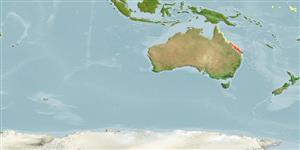
Southwestern Pacific: endemic to Australia.
Tamaño / Peso / Edad
Madurez: Lm ? range ? - ? cm
Max length : 3.1 cm SL macho / no sexado; (Ref. 54832); 3.0 cm SL (female)
Descripción breve
Claves de identificación | Morfología | Morfometría
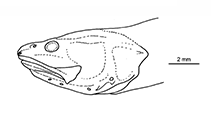
Radios blandos dorsales (total) : 78 - 80; Radios blandos anales: 62 - 63; Vértebra: 48. A species of Microbrotula distinguished by the following set of characters: vertebrae 12 + 36 = 48; D 78-80, A 62-63, pectoral-fin rays 11, caudal fin rays 6; dorsal-fin origin above vertebra 7; anterior anal fin origin below dorsal fin ray 21; anal-fin origin below vertebrae 15–17; head with separated scale patches on cheek and occiput, absent on opercle; numerous papillae on entire head; no lateral-line papillae; forward-curved spine at lower angle of preopercle with two points, hidden by skin; 3 posterior mandibular pores, 1 lower preopercular pore; palatine with papillae-like teeth; elongated otolith, length to height, 2.3; otolith length to colliculum length, 2.3 (Ref. 88975).
Body shape (shape guide): elongated.
Ciclo vital y comportamiento de apareamiento
Madurez | Reproducción | Puesta | Huevos | Fecundidad | Larva
Anderson, M.E., 2005. Three new species of Microbrotula (Teleostei: Ophidiiformes: Bythitidae) from the Indo-West Pacific. Zootaxa 1006:33-42. (Ref. 54832)
Situación en la Lista Roja de la UICN (Ref. 130435: Version 2025-2 (Global))
Amenaza para el ser humano
Harmless
Usos humanos
Herramientas
Informes especiales
Descargar XML
Fuentes de Internet
Estimaciones basadas en modelos
Temperatura preferida (Referencia
123201): 26.1 - 26.4, mean 26.1 °C (based on 6 cells).
Índice de diversidad filogenética (Referencia
82804): PD
50 = 0.5039 [Uniqueness, from 0.5 = low to 2.0 = high].
Bayesian length-weight: a=0.00479 (0.00192 - 0.01191), b=3.03 (2.81 - 3.25), in cm total length, based on LWR estimates for this (Sub)family-body shape (Ref.
93245).
Nivel trófico (Referencia
69278): 3.1 ±0.5 se; based on size and trophs of closest relatives
Resiliencia (Referencia
120179): Alto, población duplicada en un tiempo mínimo inferior a 15 meses (Preliminary K or Fecundity.).
Vulnerabilidad pesquera (Ref.
59153): Low vulnerability (10 of 100).
🛈