Classificação / Nomes
Nomes comuns | Sinónimos | Catalog of Fishes(Género, Espécies) | ITIS | CoL | WoRMS | Cloffa
>
Cyprinodontiformes (Rivulines, killifishes and live bearers) >
Rivulidae (Rivulines) > Rivulinae
Etymology: kirovskyi: Named in honor of the biologist Alexandre Kirovsky, collector of most specimens of the type series.
Eponymy: Alexandre Lantelme Kirovsky (d: 1968) is a Brazilian biologist. [...] (Ref. 128868), visit book page.
More on author: Costa.
Ambiente: milieu / zona climática / intervalo de profundidade / gama de distribuição
Ecologia
; Água doce bentopelágico. Tropical
South America: lower rio Negro drainage in Brazil.
Tamanho / Peso / Idade
Maturidade: Lm ? range ? - ? cm
Max length : 2.3 cm SL macho/indeterminado; (Ref. 54752); 1.7 cm SL (female)
Descrição breve
Chaves de identificação | Morfologia | Morfometria
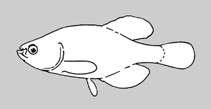
Raios dorsais moles (total) : 6 - 7; Raios anais moles: 9 - 10; Vértebras: 29 - 30. Similar to Rivulus amanapira, R. atratus, R. ornatus, R. rectocaudatus, R. romeri, R. tecminae and R. uakti and differs from all other species of the genus by having a frontal squamation pattern consisting of one scale with all margins exposed just posterior to snout (vs. scale with all margins exposed near the center of median portion of frontal region) and an oblique infraorbital dark gray bar through chin (vs. never a similar color pattern). Also similar to R. atratus, R. ornatus and R. romeri and distinguished from the remaining congeners by possessing fewer anal-fin rays (8-10, vs. 11-19). Differs from R. atratus, R. ornatus and R. romeri by having a marginal dark reddish brown stripe on the caudal fin in males (vs. dark marginal stripes absent). Differs further from R. atratus and R. ornatus by the absence of dermosphenotic (vs. presence), absence of preopercular canal (vs. conspicuous short canal), and frontal scales arranged transversally (vs. circularly). Distinguished from R. romeri by having short anal fin, its tip reaching vertical through caudal peduncle (vs. long anal fin in males, tip reaching vertical through caudal-fin base), 32 scales on the longitudinal series (vs. 29-30), 16 scale rows around caudal peduncle (vs. 12) and six branchiostegal rays vs. five (Ref. 54752).
Ciclo de vida e comportamento de acasalamento
Maturidade | Reprodução | Desova | Ovos | Fecundidade | Larvas
Costa, W.J.E.M., 2004. Rivulus kirovskyi, a new killerfish from the central Amazon, Brazil (Cyprinodontiformes: Rivulidae). Neotrop. Ichthyol. 2(1):9-12. (Ref. 54752)
Categoria na Lista Vermelha da IUCN (Ref. 130435: Version 2025-2 (Global))
Ameaça para o homem
Harmless
Utilização humana
Ferramentas
Relatórios especiais
Descarregue XML
Fontes da internet
Estimativas baseadas em modelos
Índice de diversidade filogenética (Ref.
82804): PD
50 = 0.5000 [Uniqueness, from 0.5 = low to 2.0 = high].
Bayesian length-weight: a=0.00661 (0.00315 - 0.01385), b=3.10 (2.92 - 3.28), in cm total length, based on LWR estimates for this (Sub)family-body shape (Ref.
93245).
Nível Trófico (Ref.
69278): 3.1 ±0.4 se; based on size and trophs of closest relatives
Resiliência (Ref.
120179): Elevada, tempo mínimo de duplicação da população menor que 15 meses (Preliminary K or Fecundity.).
Vulnerabilidade da pesca (Ref.
59153): Low vulnerability (10 of 100).
🛈