>
Gobiiformes (Gobies) >
Gobiidae (Gobies) > Gobiinae
Etymology: Trimma: Greek, trimma, -atos = something crushed (Ref. 45335); marinae: Named for Marina, one of the many names attributed to Aphrodite in her persona as Goddess of the Sea; also after the name of author's daughter.
Eponymy: Marina is one of many names attributed to the goddess Aphrodite, whose legendary beauty is reminiscent of this “gorgeous little species”; it is also, coincidentally, the name of Winterbottom’s daughter, “whose cheerful assistance in collecting and [...] (Ref. 128868), visit book page.
More on author: Winterbottom.
Ambiente: milieu / zona climatica / distribuzione batimetrica / gamma di distribuzione
Ecologia
marino associati a barriera corallina; distribuzione batimetrica 9 - 26 m (Ref. 55345). Subtropical
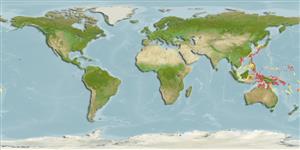
Western Pacific: Japan, New Guinea and Palau.
Dimensione / Peso / Età
Maturità: Lm ? range ? - ? cm
Max length : 2.0 cm SL maschio/sesso non determinato; (Ref. 55345); 2.0 cm SL (female)
Breve descrizione
Chiavi di identificazione | Morfologia | Morfometria
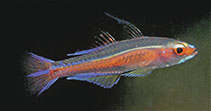
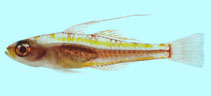
Spine dorsali (totale) : 7; Raggi dorsali molli (totale) : 8; Spine anali: 1; Raggi anali molli: 8. Diagnosis: Predorsal scales and a bony interorbital about pupil diameter in width. Second dorsal spine elongated. Fifth pelvic fin ray branched dichotomously once and 55-80% of the fourth. Scales on cheek absent; one or two cycloid scales on the upper opercle; usually two rows of scales anterior to the pelvic fin base. Snout and lower half of the caudal peduncle with a slight sprinkling of melanophores. A broad, rounded, median ridge present on the snout and anterior interorbital region. Unique to the genus, a large, bilateral, open nasal pit, instead of the usual nasal sac with anterior and posterior openings (Ref. 55345); characterized further by semi-translucent pinkish, abdomen and most of head reddish pink, merging with tapered pink stripe to middle caudal fin base; midline of snout with blue-white spot; internal white stripe above vertebral column; longitudinal scale series 23-25; predorsal scales 6-8 (Ref. 90102).
Body shape (shape guide): fusiform / normal; Cross section: compressed.
Collected from a quiet, sheltered bay (Ref. 55345). Inhabits sheltered bays in 9-26 m (Ref. 90102).
Ciclo vitale e comportamento di accoppiamento
Maturità | Riproduzione | Deposizione | Uova | Fecondità | Larve
Winterbottom, R., 2005. Two new species of the Trimma tevegae species group from the Western Pacific (Percomorpha: Gobiidae). aqua, J. Ichthyol. Aquat. Biol. 10(1):29-38. (Ref. 55345)
Stato della Lista Rossa IUCN (Ref. 130435: Version 2025-2 (Global))
Minaccia per l'uomo
Harmless
Usi umani
Pesca: di nessun interesse
Strumenti
Rapporti speciali
Scarica XML
Fonti Internet
Stime basate su modelli
Temperatura preferita (Fonte Biblio.
123201): 25.2 - 29.3, mean 28.7 °C (based on 1128 cells).
Indice di diversità filogenetica (Fonte Biblio.
82804): PD
50 = 0.5000 [Uniqueness, from 0.5 = low to 2.0 = high].
Bayesian length-weight: a=0.01023 (0.00477 - 0.02194), b=3.01 (2.83 - 3.19), in cm total length, based on LWR estimates for this (Sub)family-body shape (Ref.
93245).
Resilienza (Fonte Biblio.
120179): Alto, tempo minimo di raddoppiamento della popolazione meno di 15 mesi (Preliminary K or Fecundity.).
Vulnerabilità della pesca (Ref.
59153): Low vulnerability (10 of 100).
🛈