Clasificación / Nombres
Nombres comunes | Sinónimos | Catalog of Fishes(Género, Especie) | ITIS | CoL | WoRMS | Cloffa
>
Siluriformes (Catfishes) >
Trichomycteridae (Pencil or parasitic catfishes) > Trichomycterinae
Etymology: Ituglanis: Greek, itys, ityos = circle + Greek, glanis = a fish that can eat the bait without touching the hook; a cat fish (Ref. 45335); epikarsticus: The specific name makes reference to the type of aquifer where the species occurs.
Entorno: milieu / zona climática / rango de profundidad / gama de distribución
Ecología
; agua dulce bentopelágico. Tropical; ? - 25°C (Ref. 55401)
South America: single set of rimstone dams in São Mateus Cave in Brazil.
Tamaño / Peso / Edad
Madurez: Lm ? range ? - ? cm
Max length : 3.4 cm SL macho / no sexado; (Ref. 55401)
Descripción breve
Claves de identificación | Morfología | Morfometría
Radios blandos dorsales (total) : 11; Radios blandos anales: 8; Vértebra: 36. Distinguished from its epigean and cave congeners by the combination of the following characters: small size (max. 3.4 cm SL); the higher degree of reduction in body pigmentation and in eye size, 2.0-2.1% HL; supraoccipital fontanel very reduced or absent; base and distal extremity of laminar surface of urohyal with similar widths, dorsal process short; posterior process of palatine as long as palatine length, medial concavity slightly rounded; maxilla with discrete medial-posterior projection; fronto-lachrymal 2/3 length of maxilla, anteriorly and posteriorly pointed; opercle with 9 odontodes and interopercle with 20-21 odontodes; 5 pairs of ribs (also observed in a juvenile of I. bambui); caudal skeleton with upper hypural plate triangular and lower one rectangular, neural spine or preural centrum with acute extremity, dorsal procurrent rays 14 and ventral 10 (Ref. 55401).
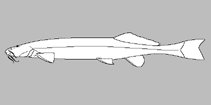
Body shape (shape guide): elongated.
Occurs in pools in a set of rimstone dams (wall-shaped barriers of calcite, aragonite or other chemical deposits that impound water pools), 10-30 cm deep and with rocky bottom (Ref. 55401). A solitary species, swimming on the bottom, along the walls and sometimes at the surface of the pools (Ref. 55401).
Ciclo vital y comportamiento de apareamiento
Madurez | Reproducción | Puesta | Huevos | Fecundidad | Larva
Bichuette, M.E. and E. Trajano, 2004. Three new subterranean species of Ituglanis from central Brazil (Siluriformes: Trichomycteridae). Ichthyol. Explor. Freshwat. 15(3):243-256. (Ref. 55401)
Situación en la Lista Roja de la UICN (Ref. 130435: Version 2025-2 (Global))
Amenaza para el ser humano
Harmless
Usos humanos
Pesquerías: sin interés
Herramientas
Informes especiales
Descargar XML
Fuentes de Internet
Estimaciones basadas en modelos
Índice de diversidad filogenética (Referencia
82804): PD
50 = 0.5000 [Uniqueness, from 0.5 = low to 2.0 = high].
Bayesian length-weight: a=0.00759 (0.00337 - 0.01709), b=3.00 (2.81 - 3.19), in cm total length, based on LWR estimates for this (Sub)family-body shape (Ref.
93245).
Nivel trófico (Referencia
69278): 3.1 ±0.4 se; based on size and trophs of closest relatives
Vulnerabilidad pesquera (Ref.
59153): Low vulnerability (10 of 100).
🛈