Mixines (mixinos) (hagfishes) >
Myxiniformes (Hagfishes) >
Myxinidae (Hagfishes) > Myxininae
Etymology: Myxine: Ancient Greek word for a slimy fish: myxa, slime; -inus, one who, referring to copious amounts of slime produced by M. glutinosa (See ETYFish); jespersenae: In honor of biologist Åse Jespersen (b. 1955), University of Copenhagen, for her contributions to the reproductive biology of hagfishes (See ETYFish).
Eponymy: Dr Åse Jespersen (d: 1955) is a Danish biologist, Associate Professor Emeritus in the Department of Biology, Marine Biological Section, Helsingør; part of the University of Copenhagen. [...] (Ref. 128868), visit book page.
Entorno: milieu / zona climática / rango de profundidad / gama de distribución
Ecología
marino batidemersal; rango de profundidad 752 - 1556 m (Ref. 54824). Deep-water
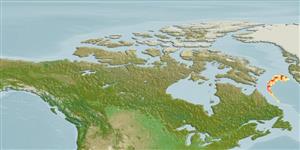
North Atlantic: off West Greenland, in the eastern Davis Strait. Denmark Strait, Reykjanes Ridge, and South East of Iceland. Occurs sympatrically with Myxine glutinosa, although with a rather limited overlap in vertical distribution (772-1556 vs. 64-782) and no documented capture of both species in the same haul or trap exists.
Tamaño / Peso / Edad
Madurez: Lm ? range ? - ? cm
Max length : 49.8 cm TL macho / no sexado; (Ref. 54824)
Descripción breve
Claves de identificación | Morfología | Morfometría
Diagnosis: Color grayish brown with whitish head, the white extending posteriorly in a mid-ventral stripe of varying length; surrounding slime pores, PCD, gill aperture, cloaca, CFF, and VFF margins whitish. Two paired, pointed, or comb-shaped, bilaterally symmetrical nasal-sinus papillae with 2-5 distal fringes and 2 cusps in each row fused at their bases. Additional cusps in anterior rows 7-9 and posterior rows 8-10; total cusps 38-44. Pairs of gill pouches 6. Slime pores: prebranchial 28-37; trunk 65-74; tail 11-15; total 107-121. Body slender, depth over cloaca 2.9-4.3% TL; ventral finfold originates within anterior 10% of trunk; caudal finfold termination dorsally above cloaca to posterior 7% of trunk (Ref. 54824).
Body shape (shape guide): eel-like.
Occurs in muddy bottoms. Eggs taken from a damaged specimen in various stages of maturation , elliptical up to 23.6 X 8.5 mm; all eggs are in mesenteries and no anchor filaments were found (Ref. 54824).
Ciclo vital y comportamiento de apareamiento
Madurez | Reproducción | Puesta | Huevos | Fecundidad | Larva
Møller, P.R., T.K. Feld, I.H. Poulsen, P.F. Thomsen and J.G. Thormar, 2005. Myxine jespersenae, a new species of hagfish (Myxiniformes: Myxinidae) from the North Atlantic Ocean. Copeia 2005(2):374-385. (Ref. 54824)
Situación en la Lista Roja de la UICN (Ref. 130435: Version 2025-2 (Global))
Amenaza para el ser humano
Harmless
Usos humanos
Herramientas
Informes especiales
Descargar XML
Fuentes de Internet
Estimaciones basadas en modelos
Temperatura preferida (Referencia
123201): 3.4 - 4, mean 3.7 °C (based on 9 cells).
Índice de diversidad filogenética (Referencia
82804): PD
50 = 0.5000 [Uniqueness, from 0.5 = low to 2.0 = high].
Bayesian length-weight: a=0.00115 (0.00045 - 0.00294), b=3.03 (2.81 - 3.25), in cm total length, based on LWR estimates for this (Sub)family-body shape (Ref.
93245).
Nivel trófico (Referencia
69278): 3.4 ±0.6 se; based on size and trophs of closest relatives
Resiliencia (Referencia
120179): Medio, población duplicada en un tiempo mínimo de 1.4-4.4 años (Preliminary K or Fecundity.).
Vulnerabilidad pesquera (Ref.
59153): Moderate vulnerability (40 of 100).
🛈