>
Characiformes (Characins) >
Anostomidae (Headstanders)
Etymology: Pseudanos: Derived from Greek, pseudes = false (Ref. 45335); winterbottomi: Named in honor of Richard Winterbottom for his significant contributions to anostomine systematics and natural history.
Eponymy: Dr Richard ‘Rick’ Winterbottom (d: 1944) is an evolutionary biologist and ichthyologist who was born in Zambia. [...] (Ref. 128868), visit book page.
Milieu: milieu / Klimaatzone / Diepte / verspreidingsgebied
Ecologie
; zoet water benthopelagisch. Tropical
South America: Rio Tapajos drainage in Brazil and throughout Rio Orinoco drainage, including the rios Casiquiare, Cinaruco, San Bartolo and Ventuari.
Grootte / Gewicht / Leeftijd
Maturiteit: Lm ? range ? - ? cm
Max length : 15.2 cm SL mannelijk / geslacht onbekend; (Ref. 55429)
Korte beschrijving
Determinatiesleutels | Morfologie | Morfometrie
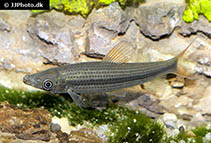
Wervels: 38 - 44. The only member of the subfamily Anostominae with a single longitudinal stripe. It also lacks transverse bars across the dorsum. Resembles P. gracilis but is distinguished by the following characters: a dark horizontal stripe along the lower half of the lateral-line scale row and the upper half of the row adjoining; four branchiostegal rays; two pores on the sensory canal of the nasal bone between its anterior and posterior openings; four pores associated with the sensory canal of infraorbital one and arranged in an approximate square; nearly complete closure of the metapterygoid/quadrate fenestra; absence of a posterior process of the ectopterygoid running ventral to the palatine in lateral view; presence of a dorsal process of the mesopterygoid that wraps around the posterior of the palatine; and a palatine with a high arch and thick, blocklike morphology (Ref. 55429).
Body shape (shape guide): fusiform / normal.
Adults are found in deep and clearwater pool (Ref. 55429). Stomach contents contain sand, woody debris and a fibrous plant material (Ref. 55429). Distinct pairs breed on densely grown weedy places (Ref. 205).
Levenscyclus en paargedrag
Maturiteit | Voortplanting | Paaien | Eieren | Fecunditeit | Larven
Distinct pairs breed on densely grown weedy places (Ref. 205).
Sidlaukas, B.L. and G.M. dos Santos, 2005. Pseudanos winterbottomi: a new anostomine species (Teleostei: Characiformes: Anostomidae) from Venezuela and Brazil, and comments on its phylogenetic relationships. Copeia 2005(1):109-123. (Ref. 55429)
Status op de Rode Lijst van het IUCN (Ref. 130435: Version 2025-2 (Global))
Gevaar voor de mens
Harmless
Gebruik door de mens
Visserij: van geen belang
Tools
Speciale rapporten
Download XML
Internetbronnen
Schattingen op basis van modellen
Fylogenetische diversiteitsindex (Ref.
82804): PD
50 = 0.5312 [Uniqueness, from 0.5 = low to 2.0 = high].
Bayesian length-weight: a=0.01072 (0.00507 - 0.02267), b=3.08 (2.91 - 3.25), in cm total length, based on LWR estimates for this (Sub)family-body shape (Ref.
93245).
Trofisch niveau (Ref.
69278): 2.5 ±0.1 se; based on size and trophs of closest relatives
Weerstandsvermogen (Ref.
120179): Hoog, minimale populatieverdubbelingstijd minder dan 15 maanden (Preliminary K or Fecundity.).
Kwetsbaarheid van de visserij (Ref.
59153): Low vulnerability (10 of 100).
🛈