Ταξινόμηση / Ονόματα
Κοινά ονόματα | Συνώνυμα | Catalog of Fishes(Γένος, Είδη) | ITIS | CoL | WoRMS | Cloffa
>
Gymnotiformes (Knifefishes) >
Gymnotidae (Naked-back knifefishes) > Gymnotinae
Etymology: Gymnotus: Greek, gymnos = naked (Ref. 45335); curupira: Named for the Igarapé Curupira, a forest stream near Tefé and the type locality of this species.
Περιβάλλον: περιβάλλον / κλιματική ζώνη / εύρος βάθους / εύρος διανομής
Οικολογία
; Γλυκού νερού βενθοπελαγικό; εύρος βάθους 0 - ? m (Ref. 55508). Tropical
South America: lowland Amazon basin in Brazil and Peru.
Μέγεθος / Βάρος / Ηλικία
Γεννητική Ωρίμανση: Lm ? range ? - ? cm
Max length : 23.5 cm TL αρσενικό/απροσδιόριστο; (Ref. 55508)
Σύντομη περιγραφή
Κλείδες προσδιορισμού | Μορφολογία | Μορφομετρία
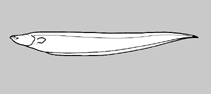
Ραχιαίες άκανθες (συνολικά) : 0; Μαλακές ραχιαίες ακτίνες (συνολικά) : 0; Μαλακές εδρικές ακτίνες: 230 - 320. Distinguished from its congeners endemic to the Amazon and Orinoco basins and the Guyana Shield in having a color pattern of 14-20 oblique, dark, pigment bands with wavy and irregular margins in which the majority of bands are branched ventrally to form inverted Y-shaped patterns (in adults), in which the dark bands are about twice as broad as the pale interbands and in which the bands rarely form X-shaped patterns at midbody. Further differs in having the following unique combination of characters: clear (unpigmented) patch at the caudal end of the anal-fin membrane in specimens 6-23.5 cm; bands never divided to form band pairs (Ref. 55508).
Facultative air-breathing in the genus (Ref. 126274); Inhabits mainly isolated swamp pools in the rain forest, which it can reach by moving over-land through moist leaf litter (Ref. 55508). Also occurs in small swamp pools that are never connected to streams and that dry out completely during periods of draught (Ref. 55508). Undertakes aerial respiration by gulping atmospheric air into the hypervascularized posterior chamber of the gas bladder (Ref. 55508). Observed to survive out of water for many hours on a moist substrate (Ref. 55508). Feeds mainly on chironomid larvae, insect nymphs and allochthonous invertebrates that fall from the forest canopy (Ref. 55508).
Κύκλος ζωής και συμπεριφορά ζευγαρώματος
Γεννητική Ωρίμανση | Αναπαραγωγή | Γεννοβολία | Αβγά | Γονιμότητα | Προνύμφες
Crampton, W.G.R., D.H. Thorsen and J.S. Albert, 2005. Three new species from a diverse, sympatric assemblage of the electric fish Gymnotus (Gymnotiformes: Gymnotidae) in the lowland Amazon basin, with notes on ecology. Copeia 2005(1):82-99. (Ref. 55508)
Κατάσταση Κόκκινου Καταλόγου IUCN (Ref. 130435: Version 2025-2 (Global))
Απειλή για τον άνθρωπο
Harmless
Ανθρώπινες χρήσεις
Εργαλεία
Ειδικές εκθέσεις
Λήψη XML
Διαδικτυακές πηγές
Εκτιμήσεις βάσει μοντέλων
Δείκτης φυλογενετικής ποικιλότητας (Αναφ.
82804): PD
50 = 0.5000 [Uniqueness, from 0.5 = low to 2.0 = high].
Bayesian length-weight: a=0.00437 (0.00209 - 0.00911), b=2.98 (2.79 - 3.17), in cm total length, based on LWR estimates for this (Sub)family-body shape (Ref.
93245).
Τροφικό Επίπεδο (Αναφ.
69278): 3.3 ±0.44 se; based on food items.
Ελαστικότητα (Αναφ.
120179): Υψηλό, ελάχιστος χρόνος για διπλασιασμό πληθυσμού < 15 μήνες (Preliminary K or Fecundity.).
Ευπάθεια στην αλιεία (Ref.
59153): Low vulnerability (14 of 100).
🛈