Klassifizierung / Names
Namen | Synonyme | Catalog of Fishes(Gattung, Arten) | ITIS | CoL | WoRMS | Cloffa
>
Kurtiformes (Nurseryfishes, cardinalfishes.) >
Apogonidae (Cardinalfishes) > Apogoninae
Etymology: Taeniamia: Name from feminine Latin noun 'taenia' meaning ribbon or band; and feminine Greek noun 'Amia' meaning a fish, often used with cardinalfishes genera. Here as Taeniamia referring to the vertical wide bars and near vertical to curved narrow bars as lines on most of the species in this genus; flavofasciata: From the Latin word 'flavus' for yellow and 'fascia' for bar or stripe, referring to the dusky yellow bars on the body.
More on authors: Gon & Randall.
Umwelt: Milieu / Klimazone / Tiefenbereich / Verbreitungsgebiet
Ökologie
seewasser pelagic-neritic; tiefenbereich 3 - 13 m (Ref. 54391). Tropical
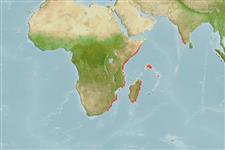
Western Indian Ocean: east coast of Africa from Mombasa, Kenya to Durban, South Afrcia, and Madagascar.
Größe / Gewicht / Alter
Geschlechtsreife: Lm ? range ? - ? cm
Max length : 7.9 cm SL Männchen/unbestimmt; (Ref. 54391)
Kurzbeschreibung
Bestimmungsschlüssel | Morphologie | Morphometrie
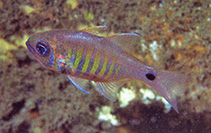
Rückenflossenstacheln (insgesamt) : 7; Rückenflossenweichstrahlen (insgesamt) : 9; Afterflossenstacheln: 2; Afterflossenweichstrahlen: 12 - 14. Diagnosis: Color in life pinkish gray with about 7 dark-edged dusky yellow bars on the side of the body; the dark caudal spot round to slightly oval, about pupil size. Rays: Dorsal VI + 1,9; Anal II,12-14; Pectoral rays 14 (rarely 15). Gill rakers 5-7 + 15-16. Lateral-line scales 25+3-4. Median predorsal scales 6 (one with 7). Body depth 2.3-2.6 in SL; body width 2.3-2.7 in body depth; eye diameter 2.5-3.25 in head length; first dorsal spine 2.6-3.4 in second spine; second dorsal spine 1.9-2.3, and third dorsal spine 1.9-2.4 in head length; spine of second dorsal fin 2.2-2.75, and second anal spine 2.5-3.05 in head length; pelvic-fin length 4.2-4.75 in SL; caudal-peduncle length 4.45-5.2 in SL; distance from insertion of pelvic spine to anal-fin origin 4.4-5.25 in SL. Posterior preopercular edge usually fully serrate. Very small teeth 1-6 , usually present in a middorsal row posteriorly on tongue; extent of scaly sheath along anal-fin base at most moderately developed (Ref. 54391).
Body shape (shape guide): short and / or deep; Cross section: compressed.
Found in seagrass beds in shallow water and was collected by trawl between 3 - 13 meters (Ref. 54391).
Lebenszyklus und Paarungsverhalten
Geschlechtsreife | Fortpflanzung | Ablaichen | Eier | Fruchtbarkeit | Larven
Gon, O. and J.E. Randall, 2003. Revision of the Indo-Pacific cardinalfish genus Archamia (Perciformes: Apogonidae), with description of a new species. Indo-Pac. Fish. (35):49 p. (Ref. 54391)
IUCN Rote Liste Status (Ref. 130435: Version 2025-2 (Global))
Bedrohung für Menschen
Harmless
Nutzung durch Menschen
Tools
Zusatzinformationen
Download XML
Internet Quellen
Schätzungen auf der Grundlage von Modellen
Bevorzugte Temperatur (Ref.
123201): 24.4 - 27.8, mean 26.9 °C (based on 223 cells).
Phylogenetischer Diversitätsindex (Ref.
82804): PD
50 = 0.5001 [Uniqueness, from 0.5 = low to 2.0 = high].
Bayesian length-weight: a=0.01514 (0.00700 - 0.03275), b=3.07 (2.89 - 3.25), in cm total length, based on LWR estimates for this (Sub)family-body shape (Ref.
93245).
Trophische Ebene (Ref.
69278): 3.5 ±0.5 se; based on size and trophs of closest relatives
Widerstandsfähigkeit (Ref.
120179): hoch, Verdopplung der Population dauert weniger als 15 Monate. (Preliminary K or Fecundity.).
Anfälligkeit der Fischerei (Ref.
59153): Low vulnerability (10 of 100).
🛈