Klassifizierung / Names
Namen | Synonyme | Catalog of Fishes(Gattung, Arten) | ITIS | CoL | WoRMS | Cloffa
Umwelt: Milieu / Klimazone / Tiefenbereich / Verbreitungsgebiet
Ökologie
; süßwasser benthopelagisch; standorttreu (Ref. 138297). Subtropical
Europe: Southern Garonne drainage in Spain and France.
Größe / Gewicht / Alter
Geschlechtsreife: Lm ? range ? - ? cm
Max length : 10.5 cm SL Männchen/unbestimmt; (Ref. 59043); max. veröff. Gewicht: 12.00 g (Ref. 89113)
Kurzbeschreibung
Bestimmungsschlüssel | Morphologie | Morphometrie
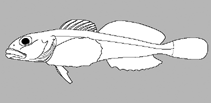
Afterflossenweichstrahlen: 11 - 14. Differs from all other European Cottus (except C. poecilopus) by having conspicuously tessellated pelvic-fin rays. Distinguished from C. poecilopus by possessing a single chin pore. Other characters useful to distinguish this species from other Cottus in Atlantic drainages include: caudal peduncle stout (length 14-19% SL, depth 7-9% SL and 1.5-2.4 times in its length); in prickling in adults (juveniles unknown); eye diameter 19-22 % HL; interorbital distance 0.9-1.3 times in eye diameter; last anal-fin ray with membrane connecting to body along 0.5 of its length; last dorsal-fin ray connected to body by a membrane along 0.5-1.0 of its length; membrane between pelvic fin and body on about 1/5 of last ray; membranes between pelvic-fin rays broad but narrower distally; lateral line complete 33-35+1 pores (Ref. 55856).
Adults inhabit streams with clear, cool, moderate to swift water, and stone substrate (Ref. 59043).
Lebenszyklus und Paarungsverhalten
Geschlechtsreife | Fortpflanzung | Ablaichen | Eier | Fruchtbarkeit | Larven
Keith, P., H. Persat, E. Feunteun and J. Allardi, 2011. Les poissons d'eau douce de France. Biotope, Mèze; Muséum national d'Histoire naturelle, Paris (collection Inventaires et biodiversité), 552 p. (Ref. 89113)
IUCN Rote Liste Status (Ref. 130435: Version 2025-2 (Global))
Bedrohung für Menschen
Harmless
Nutzung durch Menschen
Fischereien: nicht kommerziell
Tools
Zusatzinformationen
Download XML
Internet Quellen
Schätzungen auf der Grundlage von Modellen
Phylogenetischer Diversitätsindex (Ref.
82804): PD
50 = 0.5000 [Uniqueness, from 0.5 = low to 2.0 = high].
Bayesian length-weight: a=0.00832 (0.00345 - 0.02005), b=3.16 (2.98 - 3.34), in cm total length, based on LWR estimates for this Genus-body shape (Ref.
93245).
Trophische Ebene (Ref.
69278): 3.3 ±0.5 se; based on size and trophs of closest relatives
Widerstandsfähigkeit (Ref.
120179): mittel, Verdopplung der Population dauert 1,4 - 4,4 Jahre. (Preliminary K or Fecundity.).
Anfälligkeit der Fischerei (Ref.
59153): Low vulnerability (10 of 100).
🛈