>
Centrarchiformes (Basses) >
Kyphosidae (Sea chubs)
Etymology: Kyphosus: Greek, kyphos = bent (Ref. 45335); hawaiiensis: Named for its range of distribution, Hawaii Islands and adjacent waters.
Environnement : milieu / zone climatique / profondeur / gamme de distribution
Écologie
marin récifal; profondeur 1 - ? m (Ref. 58302). Tropical
Distribution
Territoires | Zones FAO | Écosystèmes | Occurrences | Carte par point | Introductions | Faunafri
Central Pacific: Hawaiian and probably in the Line Island groups (Ref. 86689).
Taille / Poids / Âge
Maturité: Lm ? range ? - ? cm
Max length : 41.0 cm TL mâle / non sexé; (Ref. 55727)
Description synthétique
Clés d'identification | Morphologie | Morphométrie
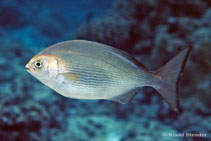
Épines dorsales (Total) : 11; Rayons mous dorsaux (Total) : 12; Épines anales: 3; Rayons mous anaux: 11; Vertèbres: 26. This species is distinguished by the following characters: body oval, deep and well compressed; mouth terminal, slightly oblique ventrally and the anterior tip o upper jaw bluntly pointed; incisiform teeth; scales on interorbital region; caudal fin emarginate, shallow; D XI,12; A III,11, anterior part of anal-fin soft-rayed portion well elevated; the longest anal-fin soft ray (second) longer than the longest dorsal-fin spine (sixth); gill rakers on lower limb of first arch on the external side 5-6 upper limb, 13-16 lower limb; pectoral fin long and broad, with 18-19 (mode 18) soft rays; pelvic fin when depressed almost reaching the anus (19.3-20.8%SL); total lateral line with 67-78 scale rows, pored scales 54-63; longitudinal row with 64-68 scale rows; vertebrae: precaudal 10, caudal 16; pterygiophores: dorsal 21 and anal 12 (Ref. 95491).
Body shape (shape guide): short and / or deep; Cross section: compressed.
Benthopelagic in shallow water, in the surge zone near coral and rocky reefs (Ref. 58302).
Cycle de vie et comportement reproducteur
Maturité | Reproduction | Frai | Œufs | Fécondité | Larves
Knudsen, S.W. and K.D. Clements, 2013. Revision of the fish family Kyphosidae (Teleostei: Perciformes). Zootaxa 3751(1):001-101. (Ref. 95491)
Statut dans la liste rouge de l'IUCN (Ref. 130435: Version 2025-2 (Global))
Menace pour l'homme
Harmless
Utilisations par l'homme
Outils
Articles particuliers
Télécharger en XML
Sources Internet
Estimations basées sur des modèles
Indice de diversité phylogénétique (Réf.
82804): PD
50 = 0.5000 [Uniqueness, from 0.5 = low to 2.0 = high].
Bayesian length-weight: a=0.01778 (0.00751 - 0.04211), b=3.01 (2.81 - 3.21), in cm total length, based on LWR estimates for this (Sub)family-body shape (Ref.
93245).
Résilience (Réf.
120179): Milieu, temps minimum de doublement de population : 1,4 à 4,4 années (Preliminary K or Fecundity.).
Vulnérabilité de la pêche (Ref.
59153): Low to moderate vulnerability (31 of 100).
🛈
Nutriments (Ref.
124155): Calcium = 50 [25, 88] mg/100g; Iron = 0.588 [0.357, 0.999] mg/100g; Protein = 18.2 [16.8, 19.4] %; Omega3 = 0.0817 [, ] g/100g; Selenium = 32.6 [17.2, 67.2] μg/100g; VitaminA = 42 [10, 169] μg/100g; Zinc = 1.42 [0.96, 2.11] mg/100g (wet weight);