Klassifizierung / Names
Namen | Synonyme | Catalog of Fishes(Gattung, Arten) | ITIS | CoL | WoRMS | Cloffa
>
Siluriformes (Catfishes) >
Sisoridae (Sisorid catfishes) > Sisorinae
Etymology: Erethistoides: Greek, erethizo = that irritates + Greek, suffix oides = similar (Ref. 45335); ascita: From the Latin adjective ascitus, meaning strange, in reference to the unusual pattern of serration on the anterior edge of the pectoral spine.
Umwelt: Milieu / Klimazone / Tiefenbereich / Verbreitungsgebiet
Ökologie
; süßwasser demersal; pH range: 7.5 - 8.0. Tropical; ? - 30°C (Ref. 55978)
Asia: Nepal.
Größe / Gewicht / Alter
Geschlechtsreife: Lm ? range ? - ? cm
Max length : 4.0 cm TL Männchen/unbestimmt; (Ref. 85009)
Kurzbeschreibung
Bestimmungsschlüssel | Morphologie | Morphometrie
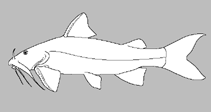
Wirbelzahl: 27 - 30. Distinguished from congeners in having serrations on the anterior edge of the pectoral spine diverging at the distal quarter (vs. middle) and in having flattened and elongate plaque-like tubercles (vs. rounded tubercles) on the head and body. Both E. ascita and E. cavatura differ from E. montana and E. pipri in having a longer caudal peduncle (19.3-22.5% SL vs. 14.4-17.3). Both species differ further from E. montana in having a more slender body (body depth at anus 8.6-10.5% SL vs. 10.6-11.4) and from E. sicula by the absence (vs. present) of slight median depression on the lower lip margin. E. ascita differs further from E. cavatura in having the serrations on the anterior edge of the pectoral spine more sideways (vs. anteriorly) directed, a smaller eye (13.2-17.6% HL vs. 17.7-20.9) and nostrils (the length of the narial complex 53-75% of interorbital width vs. 77-90), and from E. sicula. In having a deeper caudal peduncle (5.4-6.2% SL vs. 4.1-5.1) (Ref. 55978).
Found in pebble and cobble riffles with moderate depth of about 20 cm (Ref. 55978).
Lebenszyklus und Paarungsverhalten
Geschlechtsreife | Fortpflanzung | Ablaichen | Eier | Fruchtbarkeit | Larven
Ng, H.H. and D.R. Edds, 2005. Two new species of Erethistoides (Teleostei: Erethistidae) from Nepal. Ichthyol. Explor. Freshwat. 16(3):239-248. (Ref. 55978)
IUCN Rote Liste Status (Ref. 130435: Version 2025-2 (Global))
Bedrohung für Menschen
Harmless
Nutzung durch Menschen
Tools
Zusatzinformationen
Download XML
Internet Quellen
Schätzungen auf der Grundlage von Modellen
Phylogenetischer Diversitätsindex (Ref.
82804): PD
50 = 0.5010 [Uniqueness, from 0.5 = low to 2.0 = high].
Bayesian length-weight: a=0.00676 (0.00310 - 0.01476), b=3.03 (2.85 - 3.21), in cm total length, based on LWR estimates for this (Sub)family-body shape (Ref.
93245).
Trophische Ebene (Ref.
69278): 3.1 ±0.4 se; based on size and trophs of closest relatives
Anfälligkeit der Fischerei (Ref.
59153): Low vulnerability (10 of 100).
🛈