Classification / Noms
Noms communs | Synonymes | Catalog of Fishes(Genre, Espèce) | ITIS | CoL | WoRMS | Cloffa
>
Siluriformes (Catfishes) >
Loricariidae (Armored catfishes) > Hypostominae
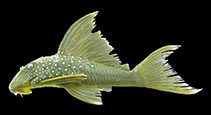
Etymology: Baryancistrus: Greek, barys = heavy + Greek, agkistron = hook (Ref. 45335); demantoides: Name from the German diemant, meaning diamond, and the Greek suffix, oides, meaning to resemble. The specific name refers to a demantoid, a type of garnet that ranges in color from yellowish green to brownish green, in reference to the color of the fish.
Environnement : milieu / zone climatique / profondeur / gamme de distribution
Écologie
; eau douce démersal. Tropical
South America: upper Rio Orinoco drainage in Venezuela.
Taille / Poids / Âge
Maturité: Lm ? range ? - ? cm
Max length : 15.1 cm SL mâle / non sexé; (Ref. 56038)
Description synthétique
Clés d'identification | Morphologie | Morphométrie
Épines dorsales (Total) : 2; Rayons mous dorsaux (Total) : 7. Distinguished from all other ancistrins by having the dorsal and adipose fins connected by an expanded posterior section of the dorsal-fin membrane, golden-yellow spots confined to the anterior portion of the body and greater than 30 teeth per jaw ramus (Ref. 56038).
Body shape (shape guide): elongated.
Occurs exclusively among granite rocks in flowing water (Ref. 56038).
Cycle de vie et comportement reproducteur
Maturité | Reproduction | Frai | Œufs | Fécondité | Larves
Werneke, D.C., M.H. Sabaj, N.K. Lujan and J.W. Armbruster, 2005. Baryancistrus demantoides and Hemiancistrus subviridis, two new uniquely colored species of catfishes from Venezuela (Siluriformes: Loricariidae). Neotrop. Ichthyol. 3(4):533-542. (Ref. 56038)
Statut dans la liste rouge de l'IUCN (Ref. 130435: Version 2025-2 (Global))
Menace pour l'homme
Harmless
Utilisations par l'homme
Outils
Articles particuliers
Télécharger en XML
Sources Internet
Estimations basées sur des modèles
Indice de diversité phylogénétique (Réf.
82804): PD
50 = 0.5039 [Uniqueness, from 0.5 = low to 2.0 = high].
Bayesian length-weight: a=0.01549 (0.00726 - 0.03306), b=2.96 (2.79 - 3.13), in cm total length, based on LWR estimates for this (Sub)family-body shape (Ref.
93245).
Résilience (Réf.
120179): Milieu, temps minimum de doublement de population : 1,4 à 4,4 années (Preliminary K or Fecundity.).
Vulnérabilité de la pêche (Ref.
59153): Low vulnerability (10 of 100).
🛈